
This section brings together the known blacksmiths who worked in and around the Village of Cazenovia from 1793 to 1947. It is the result of ongoing research into the tradesmen who shaped the daily life, economy, and physical landscape of this community for more than a century and a half. Their shops stood at crossroads, mill corners, farm lanes, and village streets; their work touched every household, farm, and traveler who passed through.
Each profile included here began as part of a weekly public history series, written to introduce one blacksmith at a time through surviving records — deeds, directories, census entries, newspaper notices, maps, and family accounts. Some men left long paper trails; others left only a line or two in a ledger. All of them contributed to the working identity of the village.
This collection is not a finished book but a living record. As new information surfaces — a photograph, a tool, a family memory, a forgotten reference in an old newspaper — the profiles will continue to grow. The goal is simple: to honor the people who practiced a demanding and essential craft, and to preserve the memory of the shops, skills, and rhythms that once defined everyday life here.
It’s easy to let them become mere figures in a story, but they lived as we do: working, wondering, struggling, choosing. Their everyday moments accumulated into legacies that still shape the landscape we walk through today.
Thank you for taking the time to explore this history. The blacksmiths of Cazenovia deserve to be remembered, and this book is one step toward ensuring that their work, their names, and their places remain part of the story of this community.
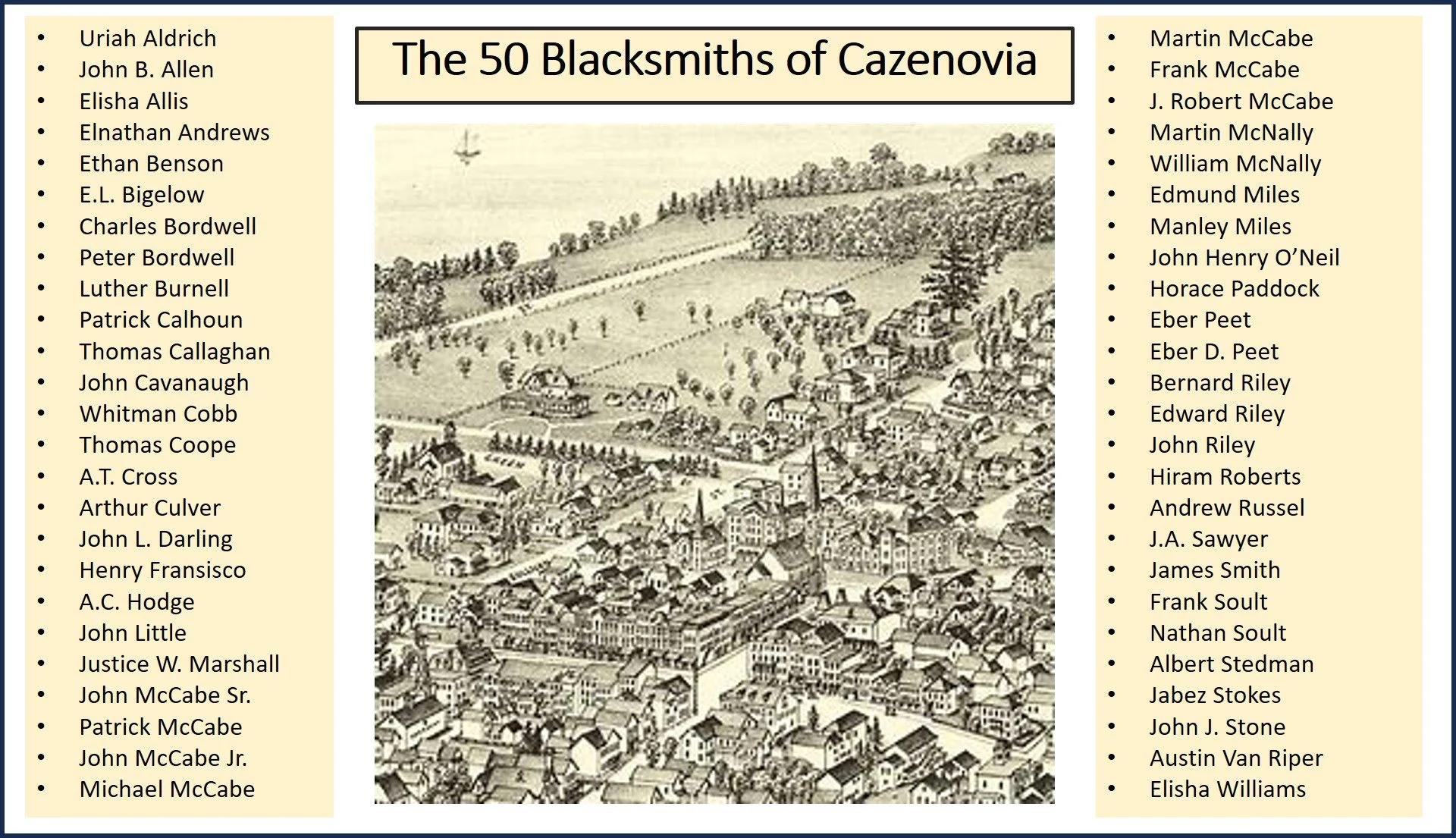
Uriah Aldrich
Uriah Aldrich was born on June 7, 1782.
Based on the information gathered to date, we know the Uriah operated from at least 1808 until 1827. We know these dates based on advertisements in Pilot in 1809 and 1817 as well as an advertisement in the Republican Monitor in 1827. He was also listed on the Village Tax Lists from 1811-1825 and the Village Register in 1827. So far, we have not been able to pinpoint the location of his shop.
One of the advertisements a “Commissioners Sale” in 1817, indicates that he may have had a bit of financial stress based on his mortgaged property being put up for Public Sale. Although we do not know the outcome of this sale, we do know that he continued to operate after this date as noted earlier.
In “Reminiscences of Thomas Farnham” as published in the Cazenovia Republican in 1874, this was noted about him:” Uriah Aldrich, blacksmith, was an amicable character, large in form and jovial in disposition. He possessed many good qualities, and others not so desirable”.
Uriah died on September 2, 1856, at the age of 74 and is buried in Evergreen Cemetery.
John B. Allen
Not a lot is known about John B. Allen (note the middle initial), and what has surfaced includes some interesting twists. His story is a good example of how challenging it can be to uncover and report local history accurately...local history sleuths are invited to dig further.
We do know that a man named John B. Allen owned and operated a blacksmith shop in Cazenovia, based on a listing in the 1827 Village of the Cazenovia Register and a Public Notice in the Republican Monitor on August 1, 1827. It is quite possible he worked as a blacksmith for many years, but no additional documentation has been found so far.
Village Tax Lists from 1816–1830 include a John Allen.
Also, Evergreen Cemetery has graves for two men:
• John Allen (1763–1840) — Revolutionary War Veteran
• John B. Allen (unknown–1846) — with the inscription: “Age 28 Yrs. 8 M’s”, meaning he was born in 1818.
This creates a problem: the younger John B. Allen would have been only nine years old in 1827, far too young to be the blacksmith listed that year. Also, information found so far indicates that the older John Allen did not have a son named John, only Rufus and Caleb. That raises the question: Was the blacksmith actually the older John Allen who died in 1840? Possibly — but the evidence is incomplete.
And another clue surfaced: an article in the August 8, 1912, Cazenovia Republican about Lottie (Charlotte) Allen Balsley, daughter of John B. Allen. The article states that her parents are buried in Evergreen Cemetery and that her grandfather served in the Revolutionary War. Lottie was born in 1845. This suggests that the younger John B. Allen — the one who died in 1846 — could indeed be her father and it also "seems" to make a line from Lottie to John B. Allen (1818-1846) and then to John Allen (1763-1840) except, we have no evidence of the older John having a son named John.
The story of John B. Allen reminds us how layered and surprising local history can be. If you have family records, cemetery notes, or old documents that might shed light on this mystery, your contributions are welcome.
Elisha Allis
Elisha was born on January 4, 1794, in Whately, MA.
He came to Cazenovia as early as 1821, based on tax and military records. While in the Military, he served as a Light Infantry Quartermaster.
It is hard to pinpoint his exact years of operation, although we can say with some certainty that he operated as a blacksmith from 1821 at least until 1833, although it is probable that he worked as a smith until he built and operated the Eagle Foundry in 1842.
The location of his shop is not known, and the only evidence found so far was from an advertisement from 1830 for Nehemiah Fisher’s Boot and Shoe Shop, which noted to be located above Elisha Allis’ Blacksmith Shop.
The Eagle Foundry was located just off Albany Street behind the blacksmith shop of Eber Peet. Both were located on the southwest corner of the bridge over the Chittenango Creek. It is likely that his blacksmithing endeavors continued at the Foundry.
We found some interesting facts about Elisha outside of his blacksmithing: He was married to Nancy Loomis and they had 5 children. He was married a second time to Diantha Stanley, and they had 7 children. In 1831, he was named Chief Engineer of the newly formed Fire Company.
In 1844, he ventured into a new enterprise as a Dealer for Dr. Foord’s Universal Pills per the advertisement in the September 11, 1844, edition of the Madison County Eagle. Click on the ad in this post to see the full advertisement.
Like another village blacksmith (Uriah Aldrich), Elisha was also remembered in the Reminiscences of Thomas Farnham as published in the Cazenovia Republican in 1874: ” Elisha Allis, blacksmith, was a man of sterling integrity and some genius. He used to manufacture the wire reeds for weaving, and I think invented some important improvements”.
Elisha Allis died on August 6, 1867, in Cazenovia.
Elnathan Andrews
All the Blacksmiths of our Village were important, but this smith holds a special distinction: he was Cazenovia’s first blacksmith. His name was Elnathan Andrews, and he arrived in 1793 as part of the initial team brought here by John Lincklaen, the founder of Cazenovia.
At that time, the group’s encampment stood at the south end of Cazenovia Lake, and it was within this temporary settlement that Elnathan built a field forge assembled from what was at hand — a simple setup that allowed for basic needs and essential repairs.
After the larger settlement began to take shape, Elnathan built his first permanent blacksmith shop in 1795.
Leading up to this, surveyors Weston and Guiteau laid out the Great Lots, including Lots 47 and 64, which are key to understanding the later location of Elnathan’s permanent shop.
· Lot 47 faced the Public Square.
· Lot 64 sat directly behind it, on the bank of the Mill Pond.
These two lots would become central to Elnathan’s home and work in the years that followed.
In 1795, Elnathan built a home and shop on what was then “company land” owned by the Holland Land Company. When Lots 47 and 64 were formally divided in 1799, the western portion—today the site of the Century House at 36 Albany Street—was granted to Elnathan by John Lincklaen on July 25th. This is the most probable location of his home. The eastern half—now 42 Albany Street—is the likely site of his blacksmith shop.
Sometime between 1795 and 1799, Elnathan entered into a partnership with Hiram Roberts, another early smith in the village.
On May 9, 1799, Elnathan appears as a founding member of the Cazenovia Masonic Lodge at its organizational meeting. But after 1800, the historical record falls silent. No further mention of Elnathan has been found, other than a possible reference to him in Skaneateles in the early 1800's.
It appears that Hiram Roberts continued operating the shop until 1803, when the property reverted back to John Lincklaen. In 1805, the land was sold to Horace Paddock, yet another blacksmith who would carry the trade forward into the next chapter of the village’s history.
Elnathan’s story may fade from the record after 1800, but his forge was the first spark of a craft that shaped the early life of our village.
Ethan Benson
Ethan was born in 1799, just as central New York was shifting from frontier to settlement. By the time he reached adulthood, Cazenovia was a thriving hill‑country village — mills running, farms expanding, trades taking root. He learned blacksmithing in that world, probably as a teenager, and by his early twenties he was established enough to sign his name to a public petition defending the village postmaster. That alone tells you he wasn’t a drifter or a boy. He was a working man with a place in the community.
Blacksmiths lived hard, physical lives. Ethan would have spent his days at the forge: iron glowing, hammer ringing, smoke thick in the rafters. He made and repaired the things that held the village together — shoes for horses, hardware for wagons, tools for farmers, fittings for mills. His work was the kind that never made the papers but made the place function.
Then the Erie Canal opened in 1825, and the world shifted under his feet. Cazenovia’s importance faded, and the new towns along the canal — Chittenango, Canastota, Lenox — exploded with opportunity. Young tradesmen followed the work north, and Ethan was one of them. He would have seen more traffic, more money, more demand for ironwork than Cazenovia could offer. So, he moved, carrying his tools and his skill into the booming corridor.
By the early 1830s he was living in or near Chittenango. The Chittenango Herald knew his name. That matters. It means he wasn’t anonymous. He was part of the fabric of the place — a man people recognized, a man whose death was worth printing.
And then, in the first days of February 1835, at just 35 or 36 years old, his life ended suddenly. The paper described “delirium tremens,” the kind of phrase editors used for a chaotic, fevered, disoriented final illness. Whether it was withdrawal, infection, exhaustion, or a collapse brought on by the brutal demands of his trade, we can’t know. But we do know he died in that town, among people who knew him, and was buried in the Canastota ground that still holds his name.
E.L. Bigelow
E. L. Bigelow was a blacksmith who appears briefly in the record. In 1847 and into early 1848, he operated the shop belonging to Peter Bordwell as evidenced by an advertisement which ran in the Madison County Whig. Peter had had been running it for a short while before turning it over to Bigelow for reasons that remain unknown. Bordwell later resumed the business and continued it into the late 1890s.
The shop stood on Albany Street, at the southeast corner of the bridge over Chittenango Creek—part of the cluster of blacksmith shops and early industries that gathered along the water. A smith working here would have handled steady horse and wagon traffic from the adjacent roadway as well as filling the needs of the nearby industrial businesses that depended on reliable ironwork.
Even if Bigelow’s time in the shop was brief, he was part of this creek‑side hub that supported the village’s daily life. His presence adds another link in the long line of smiths who worked along the water and helped shape the community’s early industry.
Peter and Charles Bordwell
Peter Bordwell and his son Charles, both longstanding blacksmiths, operated on Albany Street from the mid‑1840s into the late 1890s. Their forge stood at the southeast corner of the bridge over Chittenango Creek, part of the small cluster of shops and early industries that gathered along the water. It was a busy location, and the Bordwell’s became familiar figures in the daily flow of village life.
Peter was born in Kent, Connecticut, in 1811 and came to Cazenovia at the age of ten with his parents, Samuel and Mary Comstock Bordwell. He married Cornelia Ann Briggs of Clockville in 1835; after her death in 1844, he married Dolly Naomi Cushing, who survived him. The family lived for many years on Fenner Street, where Peter remained for the rest of his life.
In 1847, Peter briefly turned the shop over to E. L. Bigelow before resuming control and continuing at the forge for decades. By the mid‑1860s, the business operated as P. Bordwell & Son, marking the steady involvement of his son Charles, who shared both the work and the property with him.
Charles, born in Cazenovia in 1842, remained active in the business into the late 1890s and lived until 1910. He and Peter rest together in Evergreen Cemetery, close to the community they served for so long.
After Peter’s death in 1899 at the age of 88, the building soon shifted to new uses, becoming the Fred Turner Grocery Store in the early 1900s.
Though the Bordwell’s left only scattered records, their long presence at the forge marks them as one of the enduring blacksmithing families of the village—part of the creek‑side hub that supported daily life for more than half a century.
Luther Burnell
Luther Burnell was an early and enterprising figure in Cazenovia’s industrial landscape. Burnell was active from the early 1800s through the 1830s. His blacksmith shop stood along the creek on what is now Riverside Drive, among the mills and workshops that relied on the steady waterpower of the Chittenango Creek. His forge was distinctive in that it housed Cazenovia’s only known triphammer, allowing him to take on heavier work than the village’s other smiths. Later historical records place his forge among the earliest water‑powered enterprises in Cazenovia, as it believed the triphammer was installed in 1811.
The existing building on Riverside Drive (second on the right as you turn off Mill Street) could well have once housed the blacksmith shop and triphammer of Mr. Burnell. We do know that his shop was in close proximity to the Selah Munson Clothier Works, which has been confirmed to have existed in a portion of this building. The origins of the current structure date back to 1807.
Burnell was born March 20, 1780, in Chesterfield, Massachusetts, and died January 29, 1839, in Cazenovia. He is buried in Evergreen Cemetery. He appears frequently in early records, with tax lists showing him in operation from 1808 to 1833. He was more than a blacksmith; he owned a grist mill and a saw mill, and in 1830 offered these—along with shingle and fulling mills—for sale.
He also took part in community life, noted in 1824 as a Director of the Madison County Bible Society.
Though the surviving record is scattered, Luther Burnell stands out as a foundational figure—an innovator whose creek‑side triphammer helped shape the working life of Cazenovia in its first decades.
Patrick Calhoun
Patrick Calhoun was a smith whose blacksmith shop stood on Nelson Street, just east of the Bordwell shop, within the well‑known cluster of nine forges that once dotted this stretch of the village. His shop was in the general vicinity of what today is the Atwell Mill Commercial and Office Building.
Through the video which can be viewed above, you can hear Patrick's story directly. Although we don't know how his voice would actually sound, please know the base photograph is authentic and the information is factual.
Calhoun worked from roughly 1890 to 1909, one of the later smiths to operate in this long‑established industrial corridor.
Calhoun was born in 1852 and died in 1909 at 57 years of age, and he is buried in St. James Cemetery. He was married to Martha E. Wilson, and they had two children, James and Martha. In the 1905 Census, he was listed as a blacksmith and carriage maker, age 52, living on Farnham Street with his family.
He was also active in village life, serving as an officer of the Owahgena Hose Company in 1897, and again elected as an officer of Hose Company No. 1 in 1904.
One of the more dramatic moments connected with his shop occurred early on July 9, 1891, when a fire broke out in the hayloft of a stable owned by Patrick Farley, located immediately south of Calhoun’s shop near the railroad. By the time the alarm was raised, flames were already breaking through the roof, threatening nearby buildings including the Grotto House. Fire crews managed to save most of Calhoun’s tools and materials, but the shop itself suffered heavy damage before the blaze was contained. Losses were estimated at several hundred dollars, partially covered by insurance.
Despite setbacks, Calhoun remained part of the East-End blacksmithing community until his death in 1909, one of many smiths who worked in this long‑standing industrial cluster.
Thomas Callaghan
In January 1895, the Brookfield Courier recorded a brief notice concerning Thomas Callaghan, a working blacksmith in Cazenovia.
According to the report, Callaghan was sentenced to ten days in jail after being found guilty of cruelly beating a horse while shoeing it. The incident occurred within the normal course of his trade, at a time when blacksmiths played a central role in maintaining the working animals and equipment of rural communities.
New York State had established anti‑cruelty laws by the late nineteenth century, and local courts occasionally issued short jail terms for violations judged serious enough to warrant confinement. The newspaper’s summary reflects the common reporting style of the period: concise, factual, and focused on the outcome rather than the circumstances. No additional details about the horse, the nature of the beating, or Callaghan’s prior reputation appear in the surviving record.
No additional information about Callaghan has been found in the surviving record.
John Cavanaugh
John Cavanaugh, labored as a blacksmith in the Albany Street shop operated by James Smith, formerly one of the McCabe family shops.
While the exact span of Cavanaugh’s employment is not fully known, he appears in a 1917 photograph standing beside James Smith, placing him squarely within the active years of Smith’s operation, which ran from 1901 to 1935.
Cavanaugh’s time in the shop was not without hardship. A report in the Oneida Union on July 11, 1911, noted that “John Cavanaugh of Cazenovia is laid up with a broken collar bone and fractured ribs, the result of a kick of a horse.” Injuries of this kind were an ever‑present risk in a blacksmith’s work, especially in a shop that handled both general forging and horse‑related tasks.
Though the surviving record offers only glimpses, John Cavanaugh stands as one of the working smiths who kept the Albany Street forge active in the early twentieth century, contributing to the long continuity of blacksmithing in that historic shop.
Whitman Cobb
Whitman Cobb, a Vermont native, became one of Cazenovia’s early and more versatile metalworkers. He was active here for certain during the 1820s and early 1830s, though the surviving record suggests he may have been working even earlier. His name appears in the 1827 Village of Cazenovia Register, placing him firmly among the established tradesmen of the period.
Cobb’s shop location was in what we know today as the parking lot for Buyea’s. A retrospective article in the Cazenovia Republican (April 14, 1877), looking back on the 1820–1830s, reports that Jacob Ten Eyck sold his foundry to Samuel Chubbuck and Whitman Cobb, who then “moved the fixings to a shop in the east of the village where Mr. Cobb had before done foundry work. It stood near where Barney Riley’s shop now is.” This account not only confirms Cobb’s presence in the east end but also indicates that he had been conducting foundry work there prior to the Ten Eyck–Chubbuck partnership.
Cobb’s work extended beyond ordinary blacksmithing. In 1830, he dissolved his partnership with Ten Eyck—known as W. Cobb & Co.—which operated in what contemporary advertisements called the “Furnace” business, a term that in the 1830s likely referred to larger‑scale ironworking such as casting or heavy forging. His operation appears to have been substantial. An 1831 Republican Monitor notice offered his blacksmith shop for lease for one to five years, noting that it contained two forges and an attached wagon shop, a large and well‑equipped setup.
By 1832, Cobb was still active, though the tone of his advertisements continued to suggest transition. One notice offered pre‑made plough shares at a discount, while another urged customers to settle their accounts “without further notice.” These hints point to a craftsman preparing to lease out or wind down his operation, even as he continued to sell off remaining stock.
The east‑end shop site itself appears to have had a long life. After Cobb’s period, it was used by A. W. Van Riper from 1852 to 1859 for his clock works which included a small blacksmithing operation dedicated to producing clock tower components and serving the general public. By around 1860, the same location was taken up by J. L. Darling, whose blacksmith shop operated there into the late 1890s. This shop thus seems to have been like others in this industrious part of the Village with a long succession of metalworking.
Though many details of his personal life remain elusive, Whitman Cobb stands out as a figure whose work bridged everyday blacksmithing and the heavier iron trades, contributing to the early industrial character of Cazenovia during a formative period. He died on February 2, 1866, at the age of 84, leaving behind a legacy embedded in the long arc of the village’s working past. He was buried in the City Cemetery in Marengo, Illinois.
Thomas Coope
Thomas Coope announced his arrival in Cazenovia through a newspaper advertisement dated April 19, 1830. In it, he stated that he had taken over the shop of E. & M. Miles and would be carrying on the blacksmithing business in all its various branches. Though the exact location of the shop is not specified, the ad places him squarely within the working trades of the village at a time when blacksmithing remained central to daily life.
Coope emphasized his punctuality and attention to business, hoping to earn a share of public patronage. He also noted that edge tools of all kinds would be kept on hand, suggesting a shop capable of producing and maintaining finer implements alongside heavier work. Like many tradesmen of the period, he accepted most kinds of produce in payment—a reminder of the barter economy that still shaped village commerce in the early 19th century.
Our research suggests that Thomas was from the Town of Scott in Cortland County. Records from later years indicate that his time in Cazenovia was likely brief; he appears to have returned to Scott, where by 1839 he was listed as a Trustee of the M.E. Church, and in 1851 he was named as a potential juror for the Circuit Court. Though no further records of his work directly in Cazenovia have surfaced, this single advertisement offers a glimpse of a smith stepping into an established shop and staking his claim with confidence and craft. His presence adds another thread to the fabric of Cazenovia’s blacksmithing history—one rooted in continuity, practical skill, and the quiet ambition of a tradesman ready to serve.
Thomas died on May 18, 1877, at age 70.
Arthur Culver
Arthur Culver was a blacksmith whose presence in Cazenovia is documented in the 1870 Federal Census, where he appears among the village’s listed blacksmiths.
Born in 1847, Culver would have been in his early twenties at the time, most likely working as an employee rather than a shop owner. His listing places him within the active network of forges operating in the village during the post‑Civil War period, a time when blacksmithing remained essential to transportation, agriculture, and daily repair work.
Little else is known about Culver’s career, and no advertisements, shop notices, or independent business records have surfaced to suggest he operated his own forge. His appearance in the census likely reflects the many working smiths whose labor sustained the village’s shops but did not leave a large paper trail. Even so, his inclusion helps round out the picture of Cazenovia’s blacksmithing community — one that relied not only on well‑documented owners but also on the skilled hands of men like Arthur Culver.
Arthur died in 1885 and is buried in the Peterboro Cemetery.
A.T. Cross
A.T. Cross, Jr. operated a versatile carriage and blacksmith shop in Cazenovia during the late 1860s and early 1870s. His business offered buggy painting, trimming, blacksmithing, repair work, and the construction of new buggies, cutters, and bob sleds. The shop’s exact location is unknown, and the full span of its operation remains uncertain, but Cross was clearly a prominent local craftsman.
Cross earned notable recognition for the quality of his work. In 1869, he was awarded Best Open Buggy at the Cazenovia Farmers and Mechanics Association Fair, a significant endorsement in a community where carriage craftsmanship was highly valued. The following year, 1870, he received the award for Best Bob Sled, further establishing his reputation for well built, reliable vehicles.
Newspaper accounts also describe Cross as an inventive mechanic. In 1869, he constructed an elegantly finished velocipede, which drew local attention and demonstrated his willingness to experiment with new forms of transportation.
By 1871, Cross was advertising cutters and bobs with bold, eye-catching graphics—evidence of both confidence in his work and a flair for promotion.
Though details of his career are incomplete, A. T. Cross, Jr. stands out as a skilled and creative craftsman whose work earned public praise and contributed to Cazenovia’s long tradition of carriage making and blacksmithing.
John Lincklaen Darling
John Lincklaen Darling was born on November 11, 1818, and lived in Cazenovia until his death on January 5, 1896. He resided on Nelson Street and is buried in Evergreen Cemetery.
By the early 1860s he was operating a blacksmith shop just off Albany Street, on ground now occupied by the entrance and parking lot of Buyea’s. In 1865, he moved to an adjacent shop, a little further off Albany Street which he operated until 1886. This shop appears to have had a long life. It is believed to have been the former forge of Whitman Cobb, and later the site used by A.W. Van Riper through 1859 for his clock works, which included a small blacksmithing operation that produced clock‑tower components. In 1886, the shop passed into the hands of John Henry O’Neil, who continued working there until he moved his operation to the old Wool Mill (just to the north) in 1895.
Darling’s own period at the forge stood within a small but active trades corridor—part of the larger Albany Street cluster of blacksmith and metalworking shops that operated there throughout the nineteenth and early twentieth centuries. In addition to general smithing, he built carriages, wagons, and sleighs, serving a community still reliant on horse‑drawn transport.
Among those who spent time in his shop were Nathan and Frank Soult, whose later blacksmith shop grew out of the experience and skills they developed while working for Darling.
Like many of the village smiths, Darling also served within the community. In 1890 he was named as a Delegate to the County Convention.
After Darling’s death in 1896, the property changed hands in 1899 when Mary Hullar purchased it, closing the chapter on his presence at the site. His shop’s footprint, though long gone, remains part of the quiet industrial thread that once defined this part of the village.
Henry Francisco
Born in New Jersey in 1800, Henry Francisco appears in the 1860 and 1870 Federal Census as a blacksmith living in the Town of Cazenovia and working in the village. His listings place him among the many tradesmen whose labor supported local forges in the mid‑nineteenth century, though no surviving record ties him to a shop of his own.
In 1860, he was living in the household of Henry and Anna Smith and their young son—likely connected through Anna, who was also born in New Jersey and is presumed to have been his daughter.
Francisco was almost certainly a working smith rather than an owner‑operator, part of the essential but often undocumented workforce that kept Cazenovia’s blacksmith shops running during years of steady demand for repairs, toolmaking, and horse‑related work. Like others who surface only in census records, he helps fill out the broader picture of the village’s blacksmithing community beyond the better‑documented shopkeepers and carriage builders.
During the years he was active, Irwin A. Forte was publishing the Cazenovia Republican, and businesses such as Haskell & Spear—a dry‑goods, grocery, and hardware store—operated at the corner of Albany and Lincklaen Streets, forming part of the commercial landscape that relied on tradesmen like him.
Though the surviving record is brief, Francisco stands among the many hands whose day‑to‑day work shaped the village’s industrial life in the decades surrounding the Civil War.
A.C. Hodge
A.C. Hodge operated a blacksmith shop in the Village of Cazenovia from 1831 to 1836 (based on information found to date), working during a period when the public square was still a place for trades and services.
His shop stood on the southwest corner of the square, occupying the opposite end from where Elnathan Andrews had kept his forge more than thirty years earlier. Andrews’ early shop stood in the area now known as 42 Albany Street, making Hodge’s location (in the vicinity of 28 or 30 Albany St.) a later counterpart across the same civic space.
Little documentation survives about Hodge’s work beyond an advertisement in the Republican Monitor in 1831, and another mention in an 1836 Meeting Notice, but his presence marks one of the transitional forges that bridged the gap between Cazenovia’s earliest blacksmiths and the more numerous shops that would emerge further down Albany Street along the creek.
John Little
Born in 1820, John Little appears in multiple census records—including the 1860 Census shown with this post—as a “master blacksmith.” In that era, the title often marked a craftsman of long experience rather than a shop owner. Earlier documentation supports this: the 1850 Census lists his occupation simply as “blacksmith,” suggesting a steady rise in skill and standing over the decade.
John Little likely worked within one of the village forges, a senior smith whose practiced hands shaped iron day after day while leaving only a small trace in the written record.
At the time of the 1860 Census, John was living in the village with his wife, Mary, and their three young children, then between three and nine years old.
He stands for the many master craftsmen whose names appear briefly in official documents—men whose quiet expertise kept the village’s tools sharp, its wagons moving, and its economy alive.