
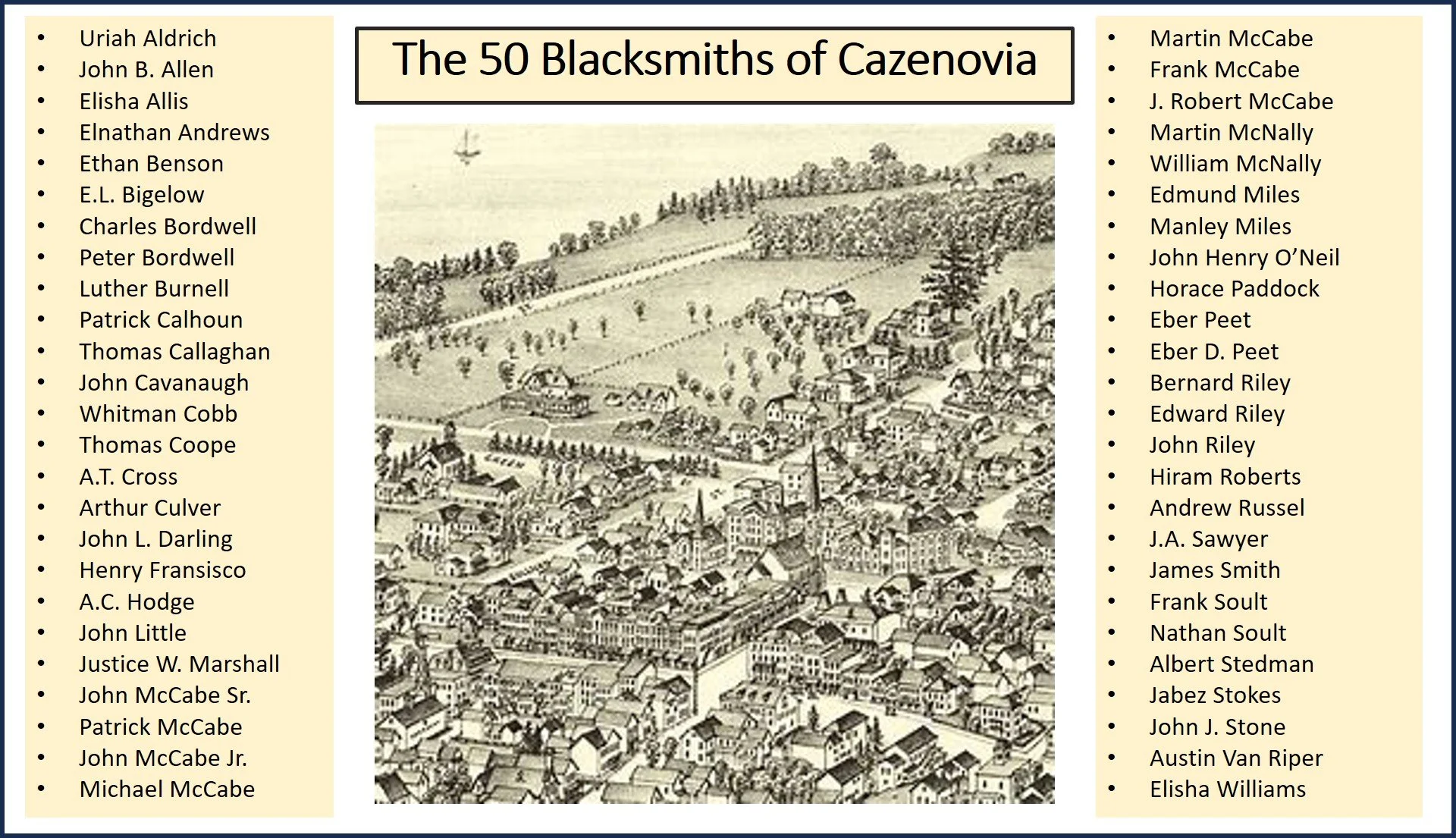
This page presents first‑person stories from three Cazenovia blacksmiths, recreated through AI, along with a static photograph of John Cavanaugh. Below these features is a complete list of the fifty Village Blacksmiths, followed by an individual narrative for each.
Patrick Calhoun
Base Photo Credit: Lorenzo State Historic SiteVideo made with Deep-Story AIJohn McCabe Jr.
Base Photo Credit: Cazenovia Public LibraryVideo made with Deep-Story AIJames A. Smith
Base Photo Credit: Lorenzo State Historic SiteVideo made with Deep-Story AI
John Cavanaugh
This section brings together the known blacksmiths who worked in and around the Village of Cazenovia from 1793 to 1947. It is the result of ongoing research into the tradesmen who shaped the daily life, economy, and physical landscape of this community for more than a century and a half. Their shops stood at crossroads, mill corners, farm lanes, and village streets; their work touched every household, farm, and traveler who passed through.
Each profile included here began as part of a weekly public history series, written to introduce one blacksmith at a time through surviving records — deeds, directories, census entries, newspaper notices, maps, and family accounts. Some men left long paper trails; others left only a line or two in a ledger. All of them contributed to the working identity of the village.
This collection is not a finished book but a living record. As new information surfaces — a photograph, a tool, a family memory, a forgotten reference in an old newspaper — the profiles will continue to grow. The goal is simple: to honor the people who practiced a demanding and essential craft, and to preserve the memory of the shops, skills, and rhythms that once defined everyday life here.
It’s easy to let them become mere figures in a story, but they lived as we do: working, wondering, struggling, choosing. Their everyday moments accumulated into legacies that still shape the landscape we walk through today.
Thank you for taking the time to explore this history. The blacksmiths of Cazenovia deserve to be remembered, and this book is one step toward ensuring that their work, their names, and their places remain part of the story of this community.
Uriah Aldrich
Uriah Aldrich was born on June 7, 1782.
Based on the information gathered to date, we know the Uriah operated from at least 1808 until 1827. We know these dates based on advertisements in Pilot in 1809 and 1817 as well as an advertisement in the Republican Monitor in 1827. He was also listed on the Village Tax Lists from 1811-1825 and the Village Register in 1827. So far, we have not been able to pinpoint the location of his shop.
One of the advertisements a “Commissioners Sale” in 1817, indicates that he may have had a bit of financial stress based on his mortgaged property being put up for Public Sale. Although we do not know the outcome of this sale, we do know that he continued to operate after this date as noted earlier.
In “Reminiscences of Thomas Farnham” as published in the Cazenovia Republican in 1874, this was noted about him:” Uriah Aldrich, blacksmith, was an amicable character, large in form and jovial in disposition. He possessed many good qualities, and others not so desirable”.
Uriah died on September 2, 1856, at the age of 74 and is buried in Evergreen Cemetery.
John B. Allen
Not a lot is known about John B. Allen (note the middle initial), and what has surfaced includes some interesting twists. His story is a good example of how challenging it can be to uncover and report local history accurately...local history sleuths are invited to dig further.
We do know that a man named John B. Allen owned and operated a blacksmith shop in Cazenovia, based on a listing in the 1827 Village of the Cazenovia Register and a Public Notice in the Republican Monitor on August 1, 1827. It is quite possible he worked as a blacksmith for many years, but no additional documentation has been found so far.
Village Tax Lists from 1816–1830 include a John Allen.
Also, Evergreen Cemetery has graves for two men:
• John Allen (1763–1840) — Revolutionary War Veteran
• John B. Allen (unknown–1846) — with the inscription: “Age 28 Yrs. 8 M’s”, meaning he was born in 1818.
This creates a problem: the younger John B. Allen would have been only nine years old in 1827, far too young to be the blacksmith listed that year. Also, information found so far indicates that the older John Allen did not have a son named John, only Rufus and Caleb. That raises the question: Was the blacksmith actually the older John Allen who died in 1840? Possibly — but the evidence is incomplete.
And another clue surfaced: an article in the August 8, 1912, Cazenovia Republican about Lottie (Charlotte) Allen Balsley, daughter of John B. Allen. The article states that her parents are buried in Evergreen Cemetery and that her grandfather served in the Revolutionary War. Lottie was born in 1845. This suggests that the younger John B. Allen — the one who died in 1846 — could indeed be her father and it also "seems" to make a line from Lottie to John B. Allen (1818-1846) and then to John Allen (1763-1840) except, we have no evidence of the older John having a son named John.
The story of John B. Allen reminds us how layered and surprising local history can be. If you have family records, cemetery notes, or old documents that might shed light on this mystery, your contributions are welcome.
Elisha Allis
Elisha was born on January 4, 1794, in Whately, MA.
He came to Cazenovia as early as 1821, based on tax and military records. While in the Military, he served as a Light Infantry Quartermaster.
It is hard to pinpoint his exact years of operation, although we can say with some certainty that he operated as a blacksmith from 1821 at least until 1833, although it is probable that he worked as a smith until he built and operated the Eagle Foundry in 1842.
The location of his shop is not known, and the only evidence found so far was from an advertisement from 1830 for Nehemiah Fisher’s Boot and Shoe Shop, which noted to be located above Elisha Allis’ Blacksmith Shop.
The Eagle Foundry was located just off Albany Street behind the blacksmith shop of Eber Peet. Both were located on the southwest corner of the bridge over the Chittenango Creek. It is likely that his blacksmithing endeavors continued at the Foundry.
We found some interesting facts about Elisha outside of his blacksmithing: He was married to Nancy Loomis and they had 5 children. He was married a second time to Diantha Stanley, and they had 7 children. In 1831, he was named Chief Engineer of the newly formed Fire Company.
In 1844, he ventured into a new enterprise as a Dealer for Dr. Foord’s Universal Pills per the advertisement in the September 11, 1844, edition of the Madison County Eagle. Click on the ad in this post to see the full advertisement.
Like another village blacksmith (Uriah Aldrich), Elisha was also remembered in the Reminiscences of Thomas Farnham as published in the Cazenovia Republican in 1874: ” Elisha Allis, blacksmith, was a man of sterling integrity and some genius. He used to manufacture the wire reeds for weaving, and I think invented some important improvements”.
Elisha Allis died on August 6, 1867, in Cazenovia.
Elnathan Andrews
All the Blacksmiths of our Village were important, but this smith holds a special distinction: he was Cazenovia’s first blacksmith. His name was Elnathan Andrews, and he arrived in 1793 as part of the initial team brought here by John Lincklaen, the founder of Cazenovia.
At that time, the group’s encampment stood at the south end of Cazenovia Lake, and it was within this temporary settlement that Elnathan built a field forge assembled from what was at hand — a simple setup that allowed for basic needs and essential repairs.
After the larger settlement began to take shape, Elnathan built his first permanent blacksmith shop in 1795.
Leading up to this, surveyors Weston and Guiteau laid out the Great Lots, including Lots 47 and 64, which are key to understanding the later location of Elnathan’s permanent shop.
· Lot 47 faced the Public Square.
· Lot 64 sat directly behind it, on the bank of the Mill Pond.
These two lots would become central to Elnathan’s home and work in the years that followed.
In 1795, Elnathan built a home and shop on what was then “company land” owned by the Holland Land Company. When Lots 47 and 64 were formally divided in 1799, the western portion—today the site of the Century House at 36 Albany Street—was granted to Elnathan by John Lincklaen on July 25th. This is the most probable location of his home. The eastern half—now 42 Albany Street—is the likely site of his blacksmith shop.
Sometime between 1795 and 1799, Elnathan entered into a partnership with Hiram Roberts, another early smith in the village.
On May 9, 1799, Elnathan appears as a founding member of the Cazenovia Masonic Lodge at its organizational meeting. But after 1800, the historical record falls silent. No further mention of Elnathan has been found, other than a possible reference to him in Skaneateles in the early 1800's.
It appears that Hiram Roberts continued operating the shop until 1803, when the property reverted back to John Lincklaen. In 1805, the land was sold to Horace Paddock, yet another blacksmith who would carry the trade forward into the next chapter of the village’s history.
Elnathan’s story may fade from the record after 1800, but his forge was the first spark of a craft that shaped the early life of our village.
Ethan Benson
Ethan was born in 1799, just as central New York was shifting from frontier to settlement. By the time he reached adulthood, Cazenovia was a thriving hill‑country village — mills running, farms expanding, trades taking root. He learned blacksmithing in that world, probably as a teenager, and by his early twenties he was established enough to sign his name to a public petition defending the village postmaster. That alone tells you he wasn’t a drifter or a boy. He was a working man with a place in the community.
Blacksmiths lived hard, physical lives. Ethan would have spent his days at the forge: iron glowing, hammer ringing, smoke thick in the rafters. He made and repaired the things that held the village together — shoes for horses, hardware for wagons, tools for farmers, fittings for mills. His work was the kind that never made the papers but made the place function.
Then the Erie Canal opened in 1825, and the world shifted under his feet. Cazenovia’s importance faded, and the new towns along the canal — Chittenango, Canastota, Lenox — exploded with opportunity. Young tradesmen followed the work north, and Ethan was one of them. He would have seen more traffic, more money, more demand for ironwork than Cazenovia could offer. So, he moved, carrying his tools and his skill into the booming corridor.
By the early 1830s he was living in or near Chittenango. The Chittenango Herald knew his name. That matters. It means he wasn’t anonymous. He was part of the fabric of the place — a man people recognized, a man whose death was worth printing.
And then, in the first days of February 1835, at just 35 or 36 years old, his life ended suddenly. The paper described “delirium tremens,” the kind of phrase editors used for a chaotic, fevered, disoriented final illness. Whether it was withdrawal, infection, exhaustion, or a collapse brought on by the brutal demands of his trade, we can’t know. But we do know he died in that town, among people who knew him, and was buried in the Canastota ground that still holds his name.
E.L. Bigelow
E. L. Bigelow was a blacksmith who appears briefly in the record. In 1847 and into early 1848, he operated the shop belonging to Peter Bordwell as evidenced by an advertisement which ran in the Madison County Whig. Peter had had been running it for a short while before turning it over to Bigelow for reasons that remain unknown. Bordwell later resumed the business and continued it into the late 1890s.
The shop stood on Albany Street, at the southeast corner of the bridge over Chittenango Creek—part of the cluster of blacksmith shops and early industries that gathered along the water. A smith working here would have handled steady horse and wagon traffic from the adjacent roadway as well as filling the needs of the nearby industrial businesses that depended on reliable ironwork.
Even if Bigelow’s time in the shop was brief, he was part of this creek‑side hub that supported the village’s daily life. His presence adds another link in the long line of smiths who worked along the water and helped shape the community’s early industry.
Peter and Charles Bordwell
Peter Bordwell and his son Charles, both longstanding blacksmiths, operated on Albany Street from the mid‑1840s into the late 1890s. Their forge stood at the southeast corner of the bridge over Chittenango Creek, part of the small cluster of shops and early industries that gathered along the water. It was a busy location, and the Bordwell’s became familiar figures in the daily flow of village life.
Peter was born in Kent, Connecticut, in 1811 and came to Cazenovia at the age of ten with his parents, Samuel and Mary Comstock Bordwell. He married Cornelia Ann Briggs of Clockville in 1835; after her death in 1844, he married Dolly Naomi Cushing, who survived him. The family lived for many years on Fenner Street, where Peter remained for the rest of his life.
In 1847, Peter briefly turned the shop over to E. L. Bigelow before resuming control and continuing at the forge for decades. By the mid‑1860s, the business operated as P. Bordwell & Son, marking the steady involvement of his son Charles, who shared both the work and the property with him.
Charles, born in Cazenovia in 1842, remained active in the business into the late 1890s and lived until 1910. He and Peter rest together in Evergreen Cemetery, close to the community they served for so long.
After Peter’s death in 1899 at the age of 88, the building soon shifted to new uses, becoming the Fred Turner Grocery Store in the early 1900s.
Though the Bordwell’s left only scattered records, their long presence at the forge marks them as one of the enduring blacksmithing families of the village—part of the creek‑side hub that supported daily life for more than half a century.
Luther Burnell
Luther Burnell was an early and enterprising figure in Cazenovia’s industrial landscape. Burnell was active from the early 1800s through the 1830s. His blacksmith shop stood along the creek on what is now Riverside Drive, among the mills and workshops that relied on the steady waterpower of the Chittenango Creek. His forge was distinctive in that it housed Cazenovia’s only known triphammer, allowing him to take on heavier work than the village’s other smiths. Later historical records place his forge among the earliest water‑powered enterprises in Cazenovia, as it believed the triphammer was installed in 1811.
The existing building on Riverside Drive (second on the right as you turn off Mill Street) could well have once housed the blacksmith shop and triphammer of Mr. Burnell. We do know that his shop was in close proximity to the Selah Munson Clothier Works, which has been confirmed to have existed in a portion of this building. The origins of the current structure date back to 1807.
Burnell was born March 20, 1780, in Chesterfield, Massachusetts, and died January 29, 1839, in Cazenovia. He is buried in Evergreen Cemetery. He appears frequently in early records, with tax lists showing him in operation from 1808 to 1833. He was more than a blacksmith; he owned a grist mill and a saw mill, and in 1830 offered these—along with shingle and fulling mills—for sale.
He also took part in community life, noted in 1824 as a Director of the Madison County Bible Society.
Though the surviving record is scattered, Luther Burnell stands out as a foundational figure—an innovator whose creek‑side triphammer helped shape the working life of Cazenovia in its first decades.
Patrick Calhoun
Patrick Calhoun was a smith whose blacksmith shop stood on Nelson Street, just east of the Bordwell shop, within the well‑known cluster of nine forges that once dotted this stretch of the village. His shop was in the general vicinity of what today is the Atwell Mill Commercial and Office Building.
Through the video which can be viewed above, you can hear Patrick's story directly. Although we don't know how his voice would actually sound, please know the base photograph is authentic and the information is factual.
Calhoun worked from roughly 1890 to 1909, one of the later smiths to operate in this long‑established industrial corridor.
Calhoun was born in 1852 and died in 1909 at 57 years of age, and he is buried in St. James Cemetery. He was married to Martha E. Wilson, and they had two children, James and Martha. In the 1905 Census, he was listed as a blacksmith and carriage maker, age 52, living on Farnham Street with his family.
He was also active in village life, serving as an officer of the Owahgena Hose Company in 1897, and again elected as an officer of Hose Company No. 1 in 1904.
One of the more dramatic moments connected with his shop occurred early on July 9, 1891, when a fire broke out in the hayloft of a stable owned by Patrick Farley, located immediately south of Calhoun’s shop near the railroad. By the time the alarm was raised, flames were already breaking through the roof, threatening nearby buildings including the Grotto House. Fire crews managed to save most of Calhoun’s tools and materials, but the shop itself suffered heavy damage before the blaze was contained. Losses were estimated at several hundred dollars, partially covered by insurance.
Despite setbacks, Calhoun remained part of the East-End blacksmithing community until his death in 1909, one of many smiths who worked in this long‑standing industrial cluster.
Thomas Callaghan
In January 1895, the Brookfield Courier recorded a brief notice concerning Thomas Callaghan, a working blacksmith in Cazenovia.
According to the report, Callaghan was sentenced to ten days in jail after being found guilty of cruelly beating a horse while shoeing it. The incident occurred within the normal course of his trade, at a time when blacksmiths played a central role in maintaining the working animals and equipment of rural communities.
New York State had established anti‑cruelty laws by the late nineteenth century, and local courts occasionally issued short jail terms for violations judged serious enough to warrant confinement. The newspaper’s summary reflects the common reporting style of the period: concise, factual, and focused on the outcome rather than the circumstances. No additional details about the horse, the nature of the beating, or Callaghan’s prior reputation appear in the surviving record.
No additional information about Callaghan has been found in the surviving record.
John Cavanaugh
John Cavanaugh, labored as a blacksmith in the Albany Street shop operated by James Smith, formerly one of the McCabe family shops.
While the exact span of Cavanaugh’s employment is not fully known, he appears in a 1917 photograph standing beside James Smith, placing him squarely within the active years of Smith’s operation, which ran from 1901 to 1935.
Cavanaugh’s time in the shop was not without hardship. A report in the Oneida Union on July 11, 1911, noted that “John Cavanaugh of Cazenovia is laid up with a broken collar bone and fractured ribs, the result of a kick of a horse.” Injuries of this kind were an ever‑present risk in a blacksmith’s work, especially in a shop that handled both general forging and horse‑related tasks.
Though the surviving record offers only glimpses, John Cavanaugh stands as one of the working smiths who kept the Albany Street forge active in the early twentieth century, contributing to the long continuity of blacksmithing in that historic shop.
Whitman Cobb
Whitman Cobb, a Vermont native, became one of Cazenovia’s early and more versatile metalworkers. He was active here for certain during the 1820s and early 1830s, though the surviving record suggests he may have been working even earlier. His name appears in the 1827 Village of Cazenovia Register, placing him firmly among the established tradesmen of the period.
Cobb’s shop location was in what we know today as the parking lot for Buyea’s. A retrospective article in the Cazenovia Republican (April 14, 1877), looking back on the 1820–1830s, reports that Jacob Ten Eyck sold his foundry to Samuel Chubbuck and Whitman Cobb, who then “moved the fixings to a shop in the east of the village where Mr. Cobb had before done foundry work. It stood near where Barney Riley’s shop now is.” This account not only confirms Cobb’s presence in the east end but also indicates that he had been conducting foundry work there prior to the Ten Eyck–Chubbuck partnership.
Cobb’s work extended beyond ordinary blacksmithing. In 1830, he dissolved his partnership with Ten Eyck—known as W. Cobb & Co.—which operated in what contemporary advertisements called the “Furnace” business, a term that in the 1830s likely referred to larger‑scale ironworking such as casting or heavy forging. His operation appears to have been substantial. An 1831 Republican Monitor notice offered his blacksmith shop for lease for one to five years, noting that it contained two forges and an attached wagon shop, a large and well‑equipped setup.
By 1832, Cobb was still active, though the tone of his advertisements continued to suggest transition. One notice offered pre‑made plough shares at a discount, while another urged customers to settle their accounts “without further notice.” These hints point to a craftsman preparing to lease out or wind down his operation, even as he continued to sell off remaining stock.
The east‑end shop site itself appears to have had a long life. After Cobb’s period, it was used by A. W. Van Riper from 1852 to 1859 for his clock works which included a small blacksmithing operation dedicated to producing clock tower components and serving the general public. By around 1860, the same location was taken up by J. L. Darling, whose blacksmith shop operated there into the late 1890s. This shop thus seems to have been like others in this industrious part of the Village with a long succession of metalworking.
Though many details of his personal life remain elusive, Whitman Cobb stands out as a figure whose work bridged everyday blacksmithing and the heavier iron trades, contributing to the early industrial character of Cazenovia during a formative period. He died on February 2, 1866, at the age of 84, leaving behind a legacy embedded in the long arc of the village’s working past. He was buried in the City Cemetery in Marengo, Illinois.
Thomas Coope
Thomas Coope announced his arrival in Cazenovia through a newspaper advertisement dated April 19, 1830. In it, he stated that he had taken over the shop of E. & M. Miles and would be carrying on the blacksmithing business in all its various branches. Though the exact location of the shop is not specified, the ad places him squarely within the working trades of the village at a time when blacksmithing remained central to daily life.
Coope emphasized his punctuality and attention to business, hoping to earn a share of public patronage. He also noted that edge tools of all kinds would be kept on hand, suggesting a shop capable of producing and maintaining finer implements alongside heavier work. Like many tradesmen of the period, he accepted most kinds of produce in payment—a reminder of the barter economy that still shaped village commerce in the early 19th century.
Our research suggests that Thomas was from the Town of Scott in Cortland County. Records from later years indicate that his time in Cazenovia was likely brief; he appears to have returned to Scott, where by 1839 he was listed as a Trustee of the M.E. Church, and in 1851 he was named as a potential juror for the Circuit Court. Though no further records of his work directly in Cazenovia have surfaced, this single advertisement offers a glimpse of a smith stepping into an established shop and staking his claim with confidence and craft. His presence adds another thread to the fabric of Cazenovia’s blacksmithing history—one rooted in continuity, practical skill, and the quiet ambition of a tradesman ready to serve.
Thomas died on May 18, 1877, at age 70.
Arthur Culver
Arthur Culver was a blacksmith whose presence in Cazenovia is documented in the 1870 Federal Census, where he appears among the village’s listed blacksmiths.
Born in 1847, Culver would have been in his early twenties at the time, most likely working as an employee rather than a shop owner. His listing places him within the active network of forges operating in the village during the post‑Civil War period, a time when blacksmithing remained essential to transportation, agriculture, and daily repair work.
Little else is known about Culver’s career, and no advertisements, shop notices, or independent business records have surfaced to suggest he operated his own forge. His appearance in the census likely reflects the many working smiths whose labor sustained the village’s shops but did not leave a large paper trail. Even so, his inclusion helps round out the picture of Cazenovia’s blacksmithing community — one that relied not only on well‑documented owners but also on the skilled hands of men like Arthur Culver.
Arthur died in 1885 and is buried in the Peterboro Cemetery.
A.T. Cross
A.T. Cross, Jr. operated a versatile carriage and blacksmith shop in Cazenovia during the late 1860s and early 1870s. His business offered buggy painting, trimming, blacksmithing, repair work, and the construction of new buggies, cutters, and bob sleds. The shop’s exact location is unknown, and the full span of its operation remains uncertain, but Cross was clearly a prominent local craftsman.
Cross earned notable recognition for the quality of his work. In 1869, he was awarded Best Open Buggy at the Cazenovia Farmers and Mechanics Association Fair, a significant endorsement in a community where carriage craftsmanship was highly valued. The following year, 1870, he received the award for Best Bob Sled, further establishing his reputation for well built, reliable vehicles.
Newspaper accounts also describe Cross as an inventive mechanic. In 1869, he constructed an elegantly finished velocipede, which drew local attention and demonstrated his willingness to experiment with new forms of transportation.
By 1871, Cross was advertising cutters and bobs with bold, eye-catching graphics—evidence of both confidence in his work and a flair for promotion.
Though details of his career are incomplete, A. T. Cross, Jr. stands out as a skilled and creative craftsman whose work earned public praise and contributed to Cazenovia’s long tradition of carriage making and blacksmithing.
John Lincklaen Darling
John Lincklaen Darling was born on November 11, 1818, and lived in Cazenovia until his death on January 5, 1896. He resided on Nelson Street and is buried in Evergreen Cemetery.
By the early 1860s he was operating a blacksmith shop just off Albany Street, on ground now occupied by the entrance and parking lot of Buyea’s. In 1865, he moved to an adjacent shop, a little further off Albany Street which he operated until 1886. This shop appears to have had a long life. It is believed to have been the former forge of Whitman Cobb, and later the site used by A.W. Van Riper through 1859 for his clock works, which included a small blacksmithing operation that produced clock‑tower components. In 1886, the shop passed into the hands of John Henry O’Neil, who continued working there until he moved his operation to the old Wool Mill (just to the north) in 1895.
Darling’s own period at the forge stood within a small but active trades corridor—part of the larger Albany Street cluster of blacksmith and metalworking shops that operated there throughout the nineteenth and early twentieth centuries. In addition to general smithing, he built carriages, wagons, and sleighs, serving a community still reliant on horse‑drawn transport.
Among those who spent time in his shop were Nathan and Frank Soult, whose later blacksmith shop grew out of the experience and skills they developed while working for Darling.
Like many of the village smiths, Darling also served within the community. In 1890 he was named as a Delegate to the County Convention.
After Darling’s death in 1896, the property changed hands in 1899 when Mary Hullar purchased it, closing the chapter on his presence at the site. His shop’s footprint, though long gone, remains part of the quiet industrial thread that once defined this part of the village.
Henry Francisco
Born in New Jersey in 1800, Henry Francisco appears in the 1860 and 1870 Federal Census as a blacksmith living in the Town of Cazenovia and working in the village. His listings place him among the many tradesmen whose labor supported local forges in the mid‑nineteenth century, though no surviving record ties him to a shop of his own.
In 1860, he was living in the household of Henry and Anna Smith and their young son—likely connected through Anna, who was also born in New Jersey and is presumed to have been his daughter.
Francisco was almost certainly a working smith rather than an owner‑operator, part of the essential but often undocumented workforce that kept Cazenovia’s blacksmith shops running during years of steady demand for repairs, toolmaking, and horse‑related work. Like others who surface only in census records, he helps fill out the broader picture of the village’s blacksmithing community beyond the better‑documented shopkeepers and carriage builders.
During the years he was active, Irwin A. Forte was publishing the Cazenovia Republican, and businesses such as Haskell & Spear—a dry‑goods, grocery, and hardware store—operated at the corner of Albany and Lincklaen Streets, forming part of the commercial landscape that relied on tradesmen like him.
Though the surviving record is brief, Francisco stands among the many hands whose day‑to‑day work shaped the village’s industrial life in the decades surrounding the Civil War.
A.C. Hodge
A.C. Hodge operated a blacksmith shop in the Village of Cazenovia from 1831 to 1836 (based on information found to date), working during a period when the public square was still a place for trades and services.
His shop stood on the southwest corner of the square, occupying the opposite end from where Elnathan Andrews had kept his forge more than thirty years earlier. Andrews’ early shop stood in the area now known as 42 Albany Street, making Hodge’s location (in the vicinity of 28 or 30 Albany St.) a later counterpart across the same civic space.
Little documentation survives about Hodge’s work beyond an advertisement in the Republican Monitor in 1831, and another mention in an 1836 Meeting Notice, but his presence marks one of the transitional forges that bridged the gap between Cazenovia’s earliest blacksmiths and the more numerous shops that would emerge further down Albany Street along the creek.
John Little
Born in 1820, John Little appears in multiple census records—including the 1860 Census shown with this post—as a “master blacksmith.” In that era, the title often marked a craftsman of long experience rather than a shop owner. Earlier documentation supports this: the 1850 Census lists his occupation simply as “blacksmith,” suggesting a steady rise in skill and standing over the decade.
John Little likely worked within one of the village forges, a senior smith whose practiced hands shaped iron day after day while leaving only a small trace in the written record.
At the time of the 1860 Census, John was living in the village with his wife, Mary, and their three young children, then between three and nine years old.
He stands for the many master craftsmen whose names appear briefly in official documents—men whose quiet expertise kept the village’s tools sharp, its wagons moving, and its economy alive.
Justice W. Marshall
After years working under Austin W. Van Riper at the Empire Clock Works, John J. Stone and Justice W. Marshall stepped forward to continue the business after Austin Van Riper’s untimely illness and death. In 1858, they purchased all of Van Riper’s patterns, drafts, tools, and machinery, ensuring that the clock‑making trade stayed in Cazenovia.
Stone and Marshall kept the shop in the same location and carried on the full range of work Van Riper had offered. They made and repaired tower clocks, but also operated a general blacksmith and machine shop, providing turning and fitting in brass, iron, and wood, along with repair and jobbing services for the community.
Their operation represented a direct continuation of Van Riper’s methods and designs. It also kept alive the long lineage of the blacksmith operation, which had earlier been run by Whitman Cobb and later by J. L. Darling.
Stone and Marshall operated the Clock Works until 1875, after which they partnered with Milton E. Card and the business transitioned to making locks and smaller castings.
The McCabe Family
The McCabe family stands as one of the most enduring and influential blacksmithing lineages in Cazenovia’s history. Their story begins with John McCabe, who emigrated from Ireland in 1848, bringing with him the trade he had practiced in his native land. Soon after arriving, he went to work for Eber Peet in Peet’s Albany Street shop, becoming a partner in 1852 and taking full ownership in 1857.
Blacksmithing quickly became a family enterprise. Four of John’s sons—Patrick, John Jr., Martin and Michael—entered the trade, followed in time by John Jr.’s son’s Frank and J. Robert. Frank would become Cazenovia’s last working blacksmith, operating until 1947. Across three generations, a McCabe stood at the forge for an extraordinary 99 years.
The family operated the Albany Street shop until 1901, when it was sold to James Smith. By then, the business had already expanded: in 1899, John Jr. opened a second shop on Lunky Lane with son Frank, who were then joined by Martin in 1901, and J. Robert coming in later on. Together, they formed a network of forges that served the village through a period of immense technological and economic change.
This collective legacy frames each McCabe not only as an individual craftsman but as part of a long, interwoven tradition that shaped Cazenovia’s working life for nearly a century.
John McCabe Sr.
John McCabe was born in 1820 in County Westmeath, Ireland, and arrived in Cazenovia in 1848 with his wife Bridget McNally and several family members. Already a respected blacksmith in Ireland, he continued his trade here under the employ of Eber Peet. His skill and reputation quickly elevated him within the shop: he became Peet’s partner in 1852 and took full ownership of the Albany Street shop in 1857—the site known today as the Red Apple Food Mart.
Over time, blacksmithing became a true family enterprise. John was joined in the business by his sons Patrick, John Jr., Michael and Martin, establishing the foundation of what would become a three‑generation blacksmithing dynasty in Cazenovia.
In 1877, John handed the operation of the Albany Street shop to his sons, and he leased the Hotaling Blacksmith Shop in Manlius, continuing to work at the forge well into his later years.
John McCabe died on December 10, 1888, and rests in St. James Cemetery, surrounded by many members of the extended McCabe family. His life marks the beginning of nearly a century of McCabe blacksmithing in Cazenovia.
Patrick McCabe
Patrick McCabe was born in 1846 in Ireland and was just two years old when the McCabe family emigrated to Cazenovia in 1848. He grew up around the family’s Albany Street blacksmith shop, learning the trade under his father’s guidance.
As a young man, Patrick spent a period in Philadelphia, where he further developed his smithing skills before returning to Cazenovia. Beginning in 1875, he entered into a full partnership with his father, working alongside him in the well‑established shop.
After several years in the family business, Patrick took a new direction and went to work for O.M. Blanchard in his blacksmith shop in DeRuyter, carrying the skills he had developed in Cazenovia into another community forge.
Patrick McCabe died in April 1899, remembered as the first of John McCabe’s sons to carry the family craft forward and extend the McCabe blacksmithing tradition beyond Cazenovia.
John McCabe Jr.
John McCabe Jr., born in 1856, was part of the second‑generation anchor of the McCabe blacksmithing dynasty in Cazenovia. Raised in the Albany Street shop founded by his father, John Sr., he learned the trade in the same forge where his father had built his reputation. By the 1870s, John Jr. had become a central figure in the daily operation of the business, working alongside his brothers Patrick, Martin, and Michael.
When his father stepped back from the Albany Street shop in 1877, the brothers assumed responsibility for its operation. They kept the business running through the final decades of the 19th century, maintaining the McCabe presence at one of the village’s most familiar work sites.
In 1899, John Jr. opened a new shop on Lunky Lane, marking a significant transition in the family’s history. The move reflected both the changing needs of the trade and the growth of the village itself. The Lunky Lane shop would become the center of McCabe blacksmithing for the next half‑century.
John Jr.’s sons, Frank and J. Robert, both entered the trade, forming the third generation of McCabe blacksmiths. Frank began apprenticing in the late 1890s at the Albany Street shop before moving with his father to Lunky Lane, while J. Robert joined him there in the early 1900’s. Their involvement confirms that the McCabe legacy was not carried by a single heir but by multiple members of the third generation, working together during a period of rapid technological change.
John Jr. died in 1930 and is buried in St. James Cemetery, surrounded by the extended McCabe family. His life represents the long middle chapter of a nearly century‑long blacksmithing tradition — the generation that sustained the trade through its busiest years and carried it forward into the modern era.
Michael McCabe
Michael McCabe was born in 1857, the third of the four McCabe sons trained by their father, John McCabe Sr., in the family’s Albany Street shop. He grew up within sight and sound of the forge, as the family home stood directly adjacent to the shop, facing Albany Street. By the 1870s—when Cazenovia’s agricultural and industrial activity remained strong—he had joined his brothers Patrick, John Jr., and Martin at the anvil.
Michael became the shop’s steady hand. Patrick and Martin spent periods working elsewhere, and John Jr. later opened a second shop on Lunky Lane (Allen St.), but Michael stayed rooted on Albany Street. His constancy anchored the original shop even as the family’s blacksmithing footprint shifted and expanded. Though never an owner, his labor supported some of the shop’s busiest times and sustained the multi‑worker capacity that defined the McCabe enterprise.
His father’s Will underscores his role: despite never being a partner, Michael was designated to inherit the Albany Street shop after his mother, Bridget McNally McCabe. His father clearly saw him as a dependable figure to carry the shop forward. That plan never materialized. Michael died in 1895, two years before his mother, and the succession outlined in the Will was never realized.
Michael is buried in St. James Cemetery. His life reflects the quiet, durable foundation of the family’s blacksmithing tradition—a craftsman whose steady presence carried the Albany Street shop through decades of daily work.
Martin McCabe
Martin McCabe, born in 1859 in Cazenovia, was the third son of John McCabe Sr. to learn the blacksmith’s trade under his father’s guiding hand. In 1887, he married Bridget Larkin, and together they raised four children.
Like his brother Patrick, Martin spent time working beyond Cazenovia. In 1894, he was plying his trade in Whitehall, New York, before returning home later in the decade. By the late 1890s, Martin and his wife had become the owners of the Albany Street shop, continuing the long McCabe association with that forge.
In 1901, Martin sold the Albany Street shop to James Smith and joined his brother John Jr. in operating the Lunky Lane shop, carrying the family’s blacksmithing tradition into its next location.
Martin also appears in the public record for an act of courage. A May 16, 1901 article in the Cazenovia Republican recounts how he and another citizen, Fred Marshall, rescued young Lizzie Stewart, who had fallen into the Chittenango Creek and nearly drowned.
Tragically, Martin’s life ended in 1908. After stepping off a train at the Walnut Street Crossing of the New York Central Railroad in Syracuse, he was struck by a passing train. He is buried in St. James Cemetery, part of the long line of McCabe's whose work shaped the daily life of Cazenovia for nearly a century.
Francis “Frank” McCabe
Frank McCabe was born in 1883, the son of John and Elizabeth McCabe, and represented the most visible figure of the third generation of McCabe blacksmiths.
He began apprenticing in the late 1890s at the Albany Street shop, learning the trade under his father and uncles. When John Jr. opened the new shop on Lunky Lane in 1899, Frank moved there with him, continuing his training and entering full‑time work in the early 1900s.
With the newly surfaced information about his brother J. Robert, it is now clear that Frank was not the sole representative of his generation in the trade. The two brothers worked together at the Lunky Lane shop, carrying the McCabe name into the 20th century.
Frank holds the distinction of being Cazenovia’s last working blacksmith, remaining at the forge until 1947. His career brought the McCabe family’s blacksmithing tenure to an extraordinary 99 years, beginning with his grandfather’s arrival from Ireland in 1848.
Frank died on February 16, 1952, and is buried in St. James Cemetery, leaving his sister Anne as the last surviving member of this branch of the family.
J. Robert McCabe
J. Robert McCabe was born in 1886, the son of John Jr. and part of the third generation of McCabe’s to enter the blacksmithing trade.
He worked at the Lunky Lane shop, the location opened by his father in 1899 as the family began transitioning from the Albany Street shop.
J. Robert’s involvement clarifies the later years of the McCabe lineage: the third generation was not represented by Frank alone, but by both brothers, working together during a period when blacksmithing was shifting toward repair and early mechanical work.
J. Robert died in 1926 and is buried in St. James Cemetery, continuing the long family presence there.
From John McCabe Sr.’s arrival in 1848 through Frank McCabe’s final year at the forge in 1947, the McCabe family shaped nearly a century of Cazenovia’s working life. Patrick, John Jr., Michael, Martin, Francis and J. Robert each carried the trade forward in their own way—shifting shops, forming partnerships, and adapting as the village changed around them. Across three generations and seven craftsmen, the sound of a McCabe hammer remained a familiar presence. Their story forms a single, unbroken line of work and place, a legacy that lasted 99 years and still echoes in the corners of the village where their shops once stood.
Martin McNally
Martin McNally was born in 1835 in Ireland, part of the extended McCabe–McNally family line that later settled in Cazenovia. He was the brother of Bridget McCabe, placing him directly within the same family that produced several of the village’s craftsmen.
By the 1860 Census, McNally was recorded as a blacksmith, almost certainly working in the McCabe shop on Albany Street, where family ties and shared trade made his presence both practical and expected. His early years in Cazenovia reflect the familiar pattern of immigrant labor: skilled work, close family networks, and a trade that provided stability.
In June 1863, McNally enlisted during the Civil War, joining the ranks of Irish‑born craftsmen who stepped forward during the conflict. After the war, he followed the westward movement common among veterans and tradesmen of his era, relocating to California, where he continued working as a blacksmith.
McNally married Rose Sloan, and together they had two daughters, establishing a new branch of the family far from his New York beginnings. He died in 1905, having carried his trade across states, decades, and the shifting landscapes of postwar America.
His life forms a distinct thread in the McCabe–McNally story — an Irish‑born craftsman whose work began in a family shop in Cazenovia and continued on the western frontier, shaped by war, migration, and the steady labor of a blacksmith.
William McNally
William McNally was born in 1837 in Ireland, part of the McNally–McCabe family that settled in Cazenovia in the mid‑19th century. He was the brother of Bridget McCabe placing him, like his brother Martin within the same family that produced several of the area’s blacksmiths.
By the 1860 Census, McNally was recorded as a blacksmith, and the family’s close ties make it likely that he worked in the McCabe shop on Albany Street, where relatives and in‑laws often shared labor and skill. His presence reflects the pattern of immigrant tradesmen who brought their craft from Ireland and found steady work in the village’s small industrial core.
William’s life was brief. He died in 1861, only a year after his census listing, and was buried in St. James Cemetery, where many members of the extended McCabe and McNally families are interred. Though the surviving record is limited, his name adds another thread to the working history of Cazenovia — a young Irish‑born blacksmith whose life ended early but whose presence helps complete the picture of the family’s craft tradition.
Edmund and Manly Miles
Brothers Edmund and Manly Miles operated a blacksmith shop in Cazenovia under the name E. & M. Miles from at least 1828 to 1830 based on tax records. Their presence is confirmed by a newspaper-announcements regarding unclaimed mail in 1829 and 1832 as well as an advertisement dated May 11, 1830, in which they announced the sale of their operation to Thomas Coope, who would carry on the blacksmithing business in all its “various branches”.
Though their tenure at the forge appears to be brief, the Miles brothers contributed to the continuity of trade in the village during a period of steady growth and transition. Their shop became the steppingstone for Coope’s arrival, linking one generation of smiths to the next.
While Manly disappears from the record after the sale, Edmund Miles remained active in the community. A notice in the September 23, 1836 edition of the Cazenovia Democrat requested his presence at a Meeting for all Farmers and Mechanics in the Town of Cazenovia, to be held at the Cazenovia House the following evening at 6:00 p.m. This suggests that Edmund continued to engage with the local trades, even after stepping away from the forge.
John Henry O’Neil
Born in Morrisville in 1859, John Henry O’Neil came to Cazenovia in 1886, establishing himself in a blacksmith shop just off Albany Street (the former shop of J.L. Darling and at least two other smiths). He worked there until 1895, when he relocated a short distance to the site of the old Wool Mill, a building with a long and varied industrial history, including being the location for Austin Van Riper’s Empire Clock Works.
For a brief period, O’Neil partnered with W.A. Hayes and T.A. Hayes under the name O’Neil, Hayes & Co., but the arrangement ended in 1896. As noted above, the building he occupied had served many roles over the years—originally a wool mill, later a machine shop, a brass fitting and turning facility, a planing mill, and a carpentry shop—before being purchased by Col. A.D. Hayes of Syracuse, who leased it to O’Neil for use as a blacksmith and carriage and wagon shop.
According to a September 6, 1945 article in the Cazenovia Republican, O’Neil continued operating his shop until 1935, marking nearly fifty years of work in the village. He died in 1939, and the building he occupied holds a unique distinction: it is the only structure in Cazenovia that can be definitively documented as having housed a blacksmith shop.
Horace Paddock
Horace Paddock first appears in the 1800 Village Census listed as a blacksmith, likely working in someone else’s shop during the earliest years of settlement. His independent role becomes clearer a few years later: based on Tax Lists and supporting documentation, Paddock purchased the blacksmith shop formerly operated by Elnathan Andrews and Hiram Roberts in 1805.
Paddock ran this shop until 1807, when he sold the property. Shortly afterward, the Madison Hotel was constructed on the site, marking the end of the forge’s presence at that location and the beginning of a new chapter in the village’s building landscape.
By 1810, Paddock had left blacksmithing behind and was working as a tavern keeper in Dryden, a shift that reflects the mobility and adaptability common among early tradesmen on the frontier.
Eber Peet and son Eber D. Peet
Eber Peet stands out as one of the most influential blacksmiths in Cazenovia’s history—not only for his long career, but for the number of shops he built, operated, and ultimately passed on to others. His work shaped the physical and economic landscape of the eastern end of Albany Street for nearly four decades.
Around 1838, Peet built his first shop on Albany Street, at the southwest corner of the bridge over the Chittenango Creek. This shop would later be sold to John McCabe, but not before Peet used it to establish himself as a central figure in the village’s working trades. In the early to mid‑1840s, he turned over operation of this shop to Jabez Stokes and constructed a second shop nearby, on the southwest corner of the bridge and creek, in the vicinity of the former Allen Tannery. This second shop was eventually sold to Peter Bordwell, linking Peet to yet another major blacksmithing lineage in the village.
In 1847, Peet took back control of his original 1838 shop from Stokes and resumed operations there. The following year, John McCabe came to work for him, becoming a partner in 1852 and ultimately purchasing the shop in 1857, beginning the McCabe family’s long tenure at the forge.
The 1860 Census lists Peet as a Master Blacksmith, age 43, with several children in the household, including Eber D. Peet, born in 1848, who would later join him in the trade.
Peet’s third major shop came in 1865, when he purchased a building on the north side of Albany Street, just west of the bridge, from John Lincklaen Darling. He raised and refitted the structure to house a blacksmith shop in the basement, continuing to expand his presence along the creek. By 1868, the firm was known as E. Peet & Son, but the partnership dissolved that same year due to the ill health of Eber D., with the elder Peet continuing the business alone.
On April 1, 1875, Peet sold the north‑side property to Barney Riley, closing out nearly forty years of continuous work on Albany Street.
It is also important to note that in between all of his blacksmith endeavors, Eber also owned and operated a Stagecoach Operation.
He owned two homes on Fenner Street, and both he and his son are buried in Evergreen Cemetery—Eber (1817–1877) and Eber D. (1848–1886).
What sets Eber Peet apart is not only the length of his career, but the three separate blacksmith shops he built, operated, and passed on.
Each became the foundation for another craftsman—McCabe, Bordwell, and Riley—making Peet a quiet but pivotal architect of Cazenovia’s blacksmithing lineage.
Riley Family – Barney & sons John and Edward
In 1875, Barney Riley took over a long‑established blacksmith shop on Albany Street, near the present‑day Fire Station and the entrance to Buyea’s. For the previous ten years, the shop had been owned and operated by Eber Peet, one of the village’s most prolific smiths. Before purchasing the property, Riley had worked for Peet as well as John McCabe, making him part of the same lineage of craftsmen who inherited and sustained Peet’s earlier shops. Riley lived on Nelson Street, placing him within easy reach of the forge he would operate for nearly a quarter century.
Riley ran the shop until 1899, after which his sons John and Ed Riley continued the business through 1924, when John passed away. Ed carried on alone until 1940, giving the family a remarkable 65‑year presence on Albany Street.
In April 1893, a fire broke out in the dwelling above Riley’s shop, spreading quickly into the attic and along the roof. Dense smoke forced firefighters to battle the blaze from the outside, cutting holes in the roof and directing water into the building until the fire was brought under control after more than an hour. The family living upstairs—Thomas Williams, his wife, and six children—escaped with most of their belongings, though many were damaged. The building suffered significant harm, but Riley’s financial loss was fully covered by insurance. The cause of the fire was never determined.
Despite the setback, the Riley family continued operating the shop for decades, becoming one of the longest‑running blacksmithing families in the village and carrying forward a line of work that stretched back through McCabe and Peet to the earliest forges on Albany Street.
Hiram Roberts
Sometime between 1795 and 1799, Elnathan Andrews, Cazenovia’s first blacksmith, entered into a partnership with Hiram Roberts, also one of the village’s early smiths. When Andrews disappears from the local record after 1800, it appears that Roberts continued operating the shop on his own. He remained at the forge until 1803, when the property reverted back to John Lincklaen. Two years later, in 1805, the land was sold to Horace Paddock, who carried the trade forward into the next chapter of Cazenovia’s blacksmithing history.
It is believed that this shop—likely the first permanent blacksmith shop in the village—stood on the eastern half of Lot 47, one of the Great Lots laid out by surveyors Weston and Guiteau during the original division of the settlement.
Village Census records from 1800 through 1803 depict Roberts as a blacksmith with a busy household and, in the final two years, as both blacksmith and tavern keeper, reflecting the dual roles common in the earliest years of the settlement. History articles published in 1928 & 1985, identifies his role in the village and the location of his Tavern.
Roberts lived a long life beyond his early Cazenovia years. He was born August 31, 1798, married February 8, 1825, and died in 1874 at the age of 76.
Andrew Russel
Andrew Russel appears in the record as a blacksmith in Cazenovia as early as 1813, with evidence of his work continuing through 1827. His shop stood at the corner of what is now Forman Street and Carpenter Street, on a parcel of land whose boundaries were well defined even if the exact shop location within it is not.
Very specific details were found through an 1827 Mortgage Sale announcement: The property stretched 170 feet north from the Mill Pond, forming the western edge of the lot. It was bordered by the land of Samuel Forman to the north, John Lincklaen to the east, the Mill Pond to the south, and the Turnpike Road to the west. The shop itself sat twelve feet below the northern boundary line, though the precise point along that line where the forge stood is not documented.
His presence from 1813 to 1827 forms an early link in the chain of craftsmen who kept the trade alive in the village’s formative years, bridging the gap between the first frontier forges and the more established shops that followed.
J.A. Sawyer
J. A. Sawyer enters the historical record through a single advertisement in the Cazenovia Republican in 1894, where J. H. O’Neil announces that he has “secured the services” of Sawyer for the coming year. Even in that brief notice, Sawyer stands out. O’Neil names him directly — unusual for the time — and emphasizes his specialty: taking “particular pains with interfering horses and horses with bad feet.”
Corrective horseshoeing was demanding work, requiring a steady hand, a patient temperament, and a practiced understanding of equine movement. Interference — when a horse’s hooves strike each other in motion — could cripple a working animal if not addressed properly. A smith who could diagnose the cause, balance the hoof, and forge a shoe to correct the problem was a valuable asset to any shop.
Beyond the advertisement, nothing more is known about Sawyer’s life or career. But that single mention places him within the working world of late‑19th‑century Cazenovia: a time when blacksmiths were still essential to transportation and agriculture, and when a good horseshoer could make the difference between a sound horse and a sidelined one. For that year, Sawyer was the man O’Neil trusted to keep the village’s horses on their feet.
James Smith
James Smith emerged as a central figure in Cazenovia’s early twentieth‑century blacksmithing scene. He had previously partnered with Martin McCabe in 1899, and in 1900 he leased the blacksmith shop of W.J. Diefendorf in New Woodstock, gaining additional experience before returning to the village.
In 1901, Smith purchased the blacksmith shop, tools, and fixtures of Martin McCabe on Albany Street, taking possession of a forge with a long lineage. The Cazenovia Republican described him that September as “a first‑class workman…well known in this locality,” a reputation that helped anchor the shop during a period of transition in the trade. Among those who worked for him was John Cavanaugh, another village smith whose career is documented in the early twentieth century.
Smith remained at the Albany Street forge until 1935, the year he stepped back from full‑time smithing. The shop was torn down soon after, and the house on the lot was moved closer to the creek and became 1 Riverside Drive. A small shop was then established beside the relocated home, where Jim continued to work part‑time for a circle of long‑standing customers. Smith then leased the land fronting Albany Street to the Tydol Oil Company for use as a gas and service station. The site continues in that role today as the Red Apple Food Mart, still selling gasoline on the same ground where the forge once stood.
Although Ed Riley continued blacksmithing in the same cluster of blacksmiths until 1941, Smith’s retirement nearly marked the end of the creek‑side smithing along Albany Street and signaled the final transition of his section of the corridor from traditional forge work to modern commercial use.
Nathan Soult and son Frank
Nathan Soult, born in 1820, operated a blacksmith shop on the east side of the Chittenango Creek at the Albany Street split to Fenner and Nelson Streets—in the vicinity of the site now occupied by the Mirabito Convenience Store. The shop operated as early as 1853, and likely earlier. His forge added another working shop to the cluster that lined both sides of the creek, shaping a dependable pocket of trade in that part of the village.
From 1875 to 1882, the shop was operated by his son Frank, marking a brief second generation of the family’s work at the forge. While they carried out their own blacksmithing at the family shop, both Nathan and Frank also partnered with J.L. Darling on carriage repair and painting, linking their work to one of the more active tradesmen in the village.
A note in the Cazenovia Republican on November 15, 1872, records that Frank Soult rented space in the rear of McCabe’s forge for use as a paint shop, suggesting an independent expansion of his skills and a connection to the larger network of smiths and carriage workers in the village.
The Soult family lived on Farnham Street, close to their place of work. Nathan died in 1875 and is buried in Evergreen Cemetery. Beyond his years at the forge, little is known about Frank, and the record grows quiet after the shop closed in 1882.
Albert Stedman
Born in 1837, Albert Stedman appears in the 1870 Federal Census as one of the blacksmiths living in the Village of Cazenovia. With no surviving advertisements, shop notices, or property records tied to his name, he was almost certainly a working smith rather than a shop owner, part of the hired labor force that moved among the village’s established forges.
Although we do not know which shop Albert may have been working at, we do know that five shops were active at the time – those operated by John McCabe, Nathan Soult, Peter Bordwell, Eber Peet and John Darling, making it highly probable he was working at one of these locations.
Stedman represents the many tradesmen whose names surface briefly in census records—skilled workers who kept up the steady flow of repairs, toolmaking, and horse‑related work during a period when Cazenovia’s shops were supporting a busy, post‑Civil War village economy.
Though the record is brief, Stedman stands among the essential hands whose day‑to‑day labor sustained the village’s blacksmithing trade.
Jabez Stokes
In 1843, Jabez Stokes purchased Eber Peet’s first Albany Street blacksmith shop, becoming the first craftsmen that Peet ushered into ownership at this important creek‑side property. His tenure was relatively short, but it sits at a pivotal moment in the shop’s lineage, bridging Peet’s early operations and the later return of the property to him. This is the same shop that would be operated by the McCabe Family for half a century and another 34 years by Jim Smith.
An 1845 advertisement in the Madison County Whig for J.D. Stratton, seller of Sanford’s Perfect Straw Cutter, notes that the machines could be viewed “in a shop adjoining Jabez Stokes’ Blacksmith Shop.” This small detail places Stokes firmly in the commercial life of the village and that his forge sat within a cluster of tradesmen whose work supported the surrounding farms and businesses.
In 1847, Stokes sold the shop back to Eber Peet, closing out his brief but clearly documented role in the evolving chain of blacksmiths along Albany Street.
John J. Stone
After years working under Austin W. Van Riper at the Empire Clock Works, John J. Stone and Justice W. Marshall stepped forward to continue the business after Austin Van Riper’s untimely illness and death. In 1858, they purchased all of Van Riper’s patterns, drafts, tools, and machinery, ensuring that the clock‑making trade stayed in Cazenovia.
Stone and Marshall kept the shop in the same location and carried on the full range of work Van Riper had offered. They made and repaired tower clocks, but also operated a general blacksmith and machine shop, providing turning and fitting in brass, iron, and wood, along with repair and jobbing services for the community.
Their operation represented a direct continuation of Van Riper’s methods and designs. It also kept alive the long lineage of the blacksmith operation, which had earlier been run by Whitman Cobb and later by J. L. Darling.
Stone and Marshall operated the Clock Works until 1875, after which they partnered with Milton E. Card and the business transitioned to making locks and smaller castings.
Austin Van Riper
Austin W. Van Riper was born in Cazenovia in 1822, part of a generation that carried the village’s early industrial energy into mid‑century. He lived at 1 Nickerson Street, just a short distance from the east‑end corridor where metalworking, foundry work, and manufacturing had been clustering since the early 1800s. From this neighborhood he built a reputation that reached well beyond Madison County: Van Riper became one of the region’s best‑known tower clock designers and builders, a craftsman whose work combined mechanical and architectural precision.
By 1852, Van Riper had established his own enterprise, the Empire Clock Works. In 1855, he partnered with Timothy Buel and relocated to the former wool mill. It appears that Buel remained a partner for only one to two years.
This site had a long lineage. The blacksmith shop portion was first associated with Whitman Cobb, one of Cazenovia’s earliest metalworkers, and later with J. L. Darling, whose blacksmith shop operated there into the late nineteenth century. Van Riper’s tenure sits squarely in the middle of this sequence, representing the period when the site shifted from general blacksmithing toward specialized mechanical manufacture before returning to its roots.
Empire Clock Works was more than a clock shop. Advertisements from the 1850s show that Van Riper maintained a blacksmith operation on site, used both for producing clock components and for serving the general public. The shop offered turning and fitting in iron, brass, or wood; machinery repair; and jobbing of every description—services that positioned Van Riper as both a precision mechanic and a traditional village smith. His tower clocks, however, were the centerpiece. They required careful drafting, pattern‑making, and metalwork, and they placed Cazenovia on the map as a producer of reliable public timepieces during a period when towns and institutions increasingly sought them.
Van Riper’s business operated until 1859, the year of his death on September 19. Prior to his passing, his patterns, tools, and drafts were purchased by his longtime employees, who continued the clock‑making trade under the same name. Their advertisements emphasize that they had worked under Van Riper for years and were thoroughly trained in his methods—a testament to the skill and discipline he brought to the craft.
Though his life was brief, Austin W. Van Riper left a distinct imprint on Cazenovia’s industrial story. He stands at the intersection of blacksmithing, mechanical innovation, and architectural timekeeping, carrying forward a site first shaped by Cobb and later sustained by Darling. His clocks, his shop, and the craftsmen he trained form a clear chapter in the village’s long tradition of metalwork and machinery.
Elisha Williams
Revolutionary Soldier • Early Cazenovia Blacksmith • Landholder • Justice of the Peace • School Shareholder
Born in 1770 in Connecticut, Elisha Williams belonged to the generation whose early adulthood intersected with the final years of the American Revolution. His service in that conflict was remembered locally: an article in the Cazenovia Republican (April 23, 1931) records that the Daughters of the American Revolution placed a plaque honoring thirty Revolutionary War soldiers from the Town of Cazenovia, including Williams.
By the late 1790s, Williams was working as a blacksmith in the Cazenovia area. A surviving receipt dated December 6, 1796, preserved at Lorenzo House, documents blacksmithing work performed for John Lincklaen. The note—signed by Frederick de Clorëcq—confirms Williams as one of the earliest tradesmen supporting the Holland Land Company’s efforts to establish the settlement’s infrastructure. His blacksmithing may have been carried out on his own farm, a common practice in rural districts of the period. The note reads:
“Mr. Lincklaen Plaise (please) to Pay to E. Williams for Blacksmith work twenty Dollar one and eight and Charge the same to the account of.”
— Your Humble Servant, Frederick de Clorëcq
Williams’ residence is firmly established in the rural district south of the village of Cazenovia, the area later served by School District No. 9. An 1883 historical account (reprinted in 1974) lists him as one of the original shareholders of the No. 9 School. Shareholders were local landowners responsible for funding, maintaining, and governing the one‑room schoolhouse. This role confirms both his landholding and his standing within the community during his prime years.
His civic responsibilities extended beyond his farm and school district. A public notice dated April 20, 1811, printed in the Pilot, lists Williams among those commissioned as Justices of the Peace of Cazenovia. His commission reflects Madison County’s trust in his judgment and character, aligning perfectly with his residence and community involvement.
Later documentation further anchors his location. An advertisement in the Madison County Whig (August 27, 1851) offered for sale the “former farm” of Elisha Williams, Esq., describing it as 86 acres just south of the village. This confirms both his landholding and his long-term residence in the No. 9 corridor. He died on April 27, 1846 and his burial in South Cemetery on Number Nine Road places him permanently within the same landscape he helped shape.
Taken together, these records form a coherent portrait: Elisha Williams was a Revolutionary War veteran, an early blacksmith serving Cazenovia’s founding generation, a landowner in the rural district south of the village, a shareholder in its school, and a county-recognized civic authority trusted to serve as Justice of the Peace. His life reflects the intertwined roles of tradesman, farmer, educator, and magistrate that defined leadership in early Madison County.