

Note: we have found multiple spellings of the name of this shop and have opted to use the name found on the Brookfield Historical Society website. (Fawcett’s/Fanet’s)
Fancett’s Blacksmith Shop - Brookfield
(Photo Credit - Dave Porter)

John B. Yates & Numerous Subsequent Owners - Chittenango
(Photo Credit - Chittenango Village Historian Office)

Conrad Smith Blacksmith Shop - Durhamville
(Photo Credit - Dave Porter)

Odell Blacksmith Shop - Erieville
(Photo Credit - NY Heritage Digital Collection)

c1900 - Erieville
(Photo credit - Thomas and Valerie Morris)

J.H. Wheaton Wagon Shop - Georgetown
(Photo Credit - Dave Porter)

Judd Family - Juddville
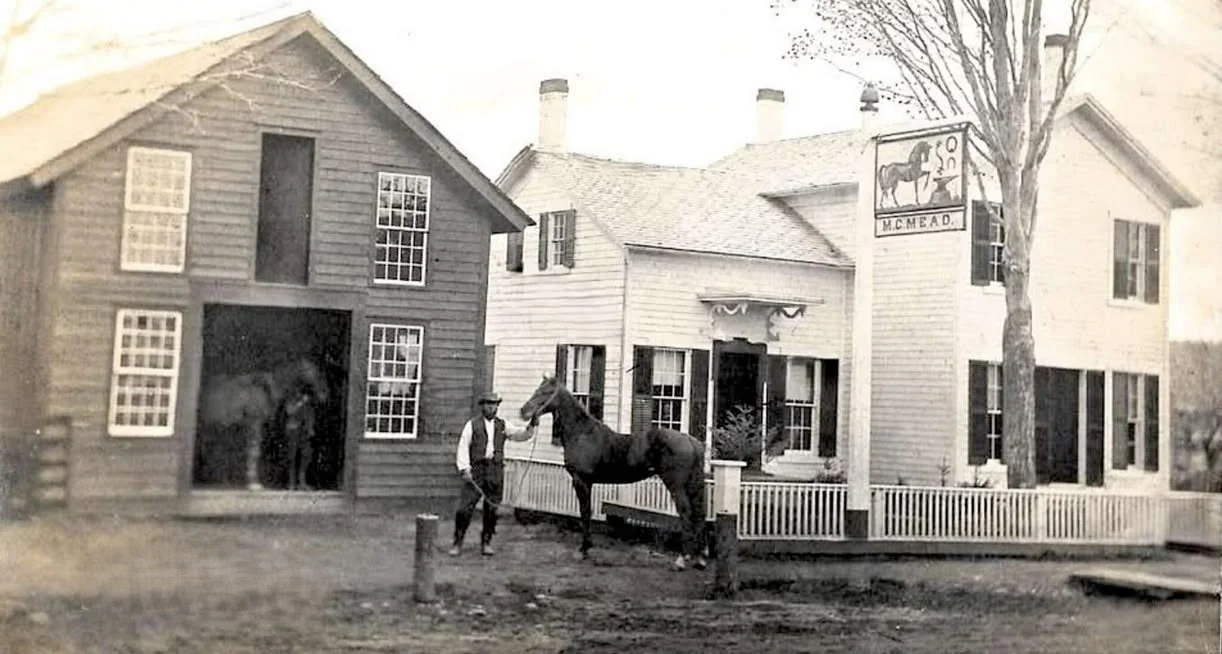
M.C. Mead - Laurens
(Photo Credit - Town of Laurens Historical Society provided by Rennie Elliott)

Frank Tyler Blacksmith Shop - Lebanon
(Photo Credit - Dave Porter)

Unnamed - Liverpool - Old Liverpool Road
(Photo Credit - NY Heritage Digital Collection)

Brigg’s Blacksmith Shop - Manlius
(Photo Credit - Dave Porter)

Joe Fabine, Blacksmith - Manlius
(Photo Credit - NY Heritage Digital Collection)

Unknown Blacksmith Shop - Manlius
(Photo Credit - NY Heritage Digital Collection)

H.S. Gorton’s Carriage & Sleigh Shop - New Woodstock
(Photo Credit - Dave Porter)

Un-named New Woodstock - Elm Street
(Photo Credit - Todd Vaas)


Unnamed - South Lebanon
(Photo Credit - Dave Porter)

F.R. Daniels Blacksmith - Sheds
(Photo Credit - Dave Porter)

J.A. Murray - Syracuse


Ira & Joe Walker - West Winfield
This next section is a listing by Hamlet and Village of the Blacksmiths who labored there.
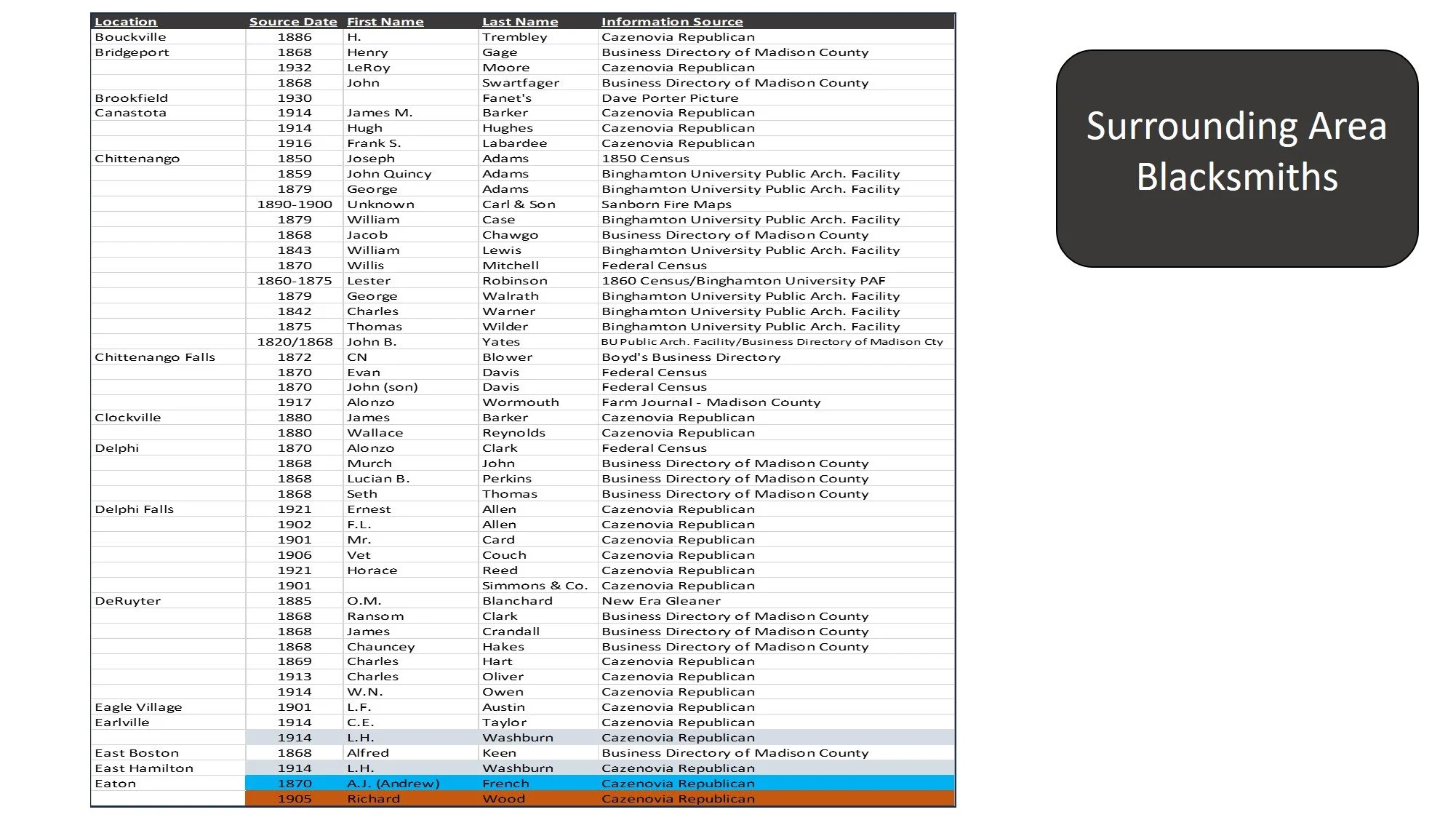
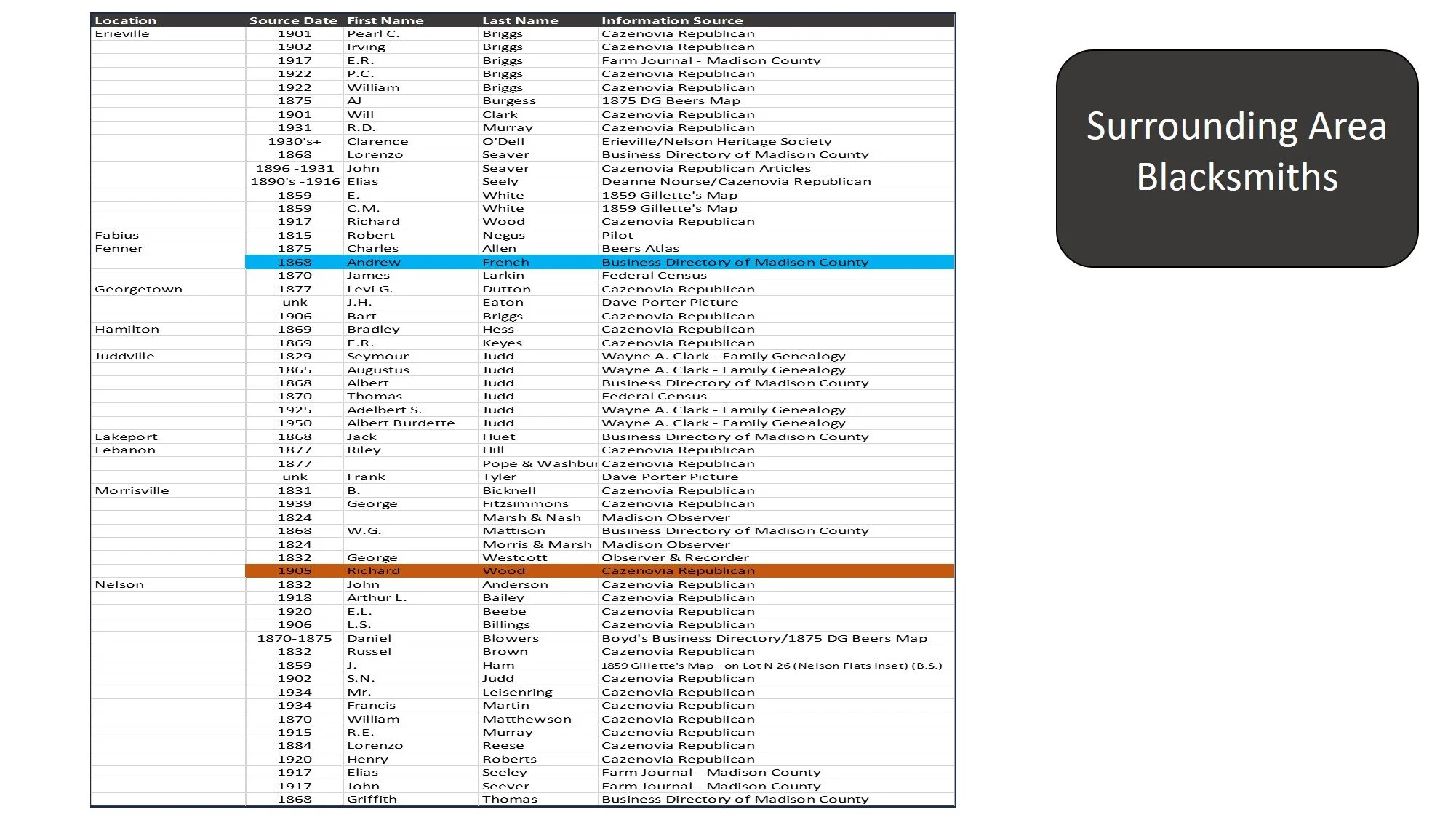
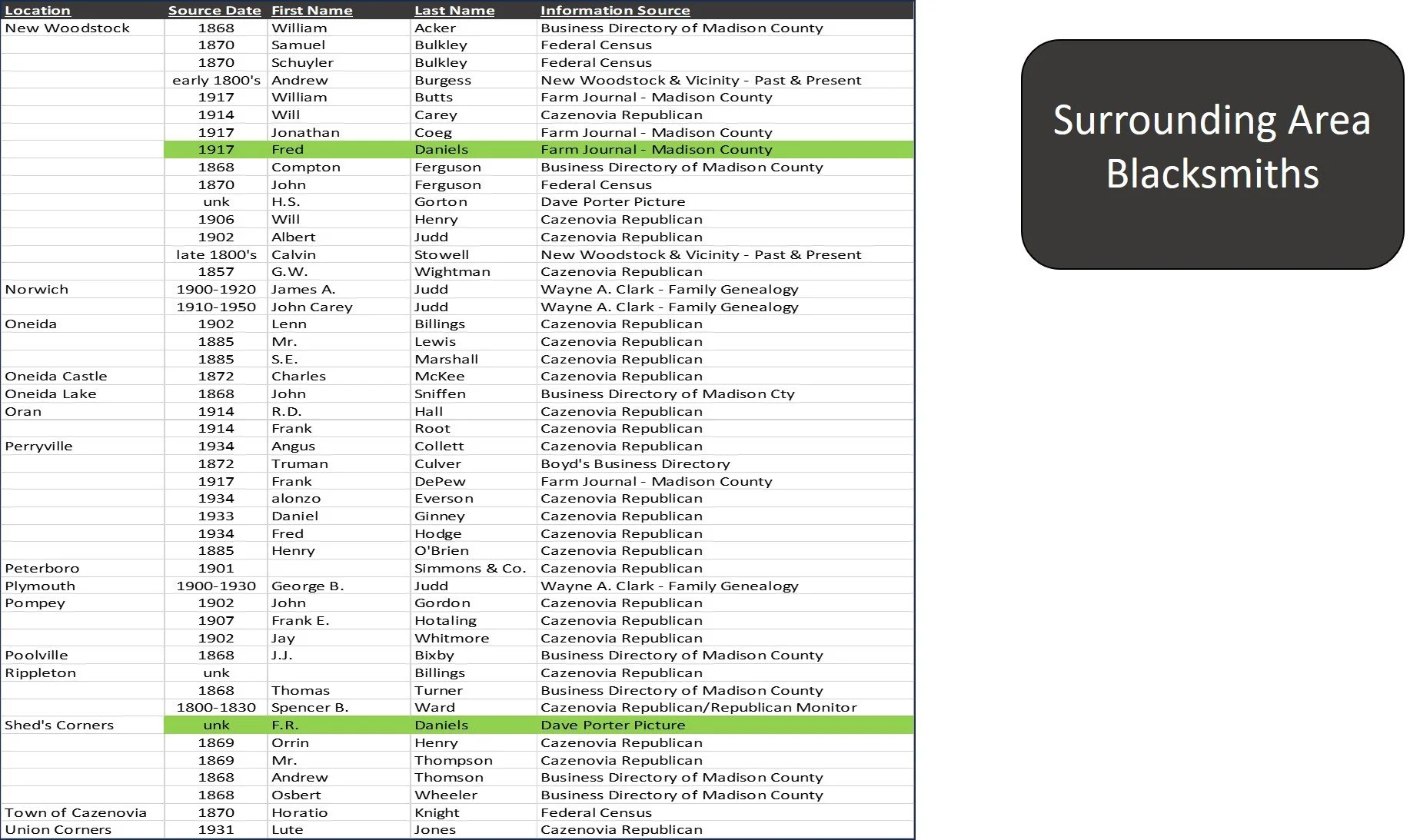
This section is a series of narratives for nearby Hamlets and Villages where Blacksmith information has been found.
If anyone has anything to add to these narratives, please let us know via the Contact Page.
Bouckville
Bouckville’s position at the junction of early roads made a working forge essential. Farmers from the surrounding hills, travelers moving between Morrisville and points east, and the small cluster of local businesses all depended on a smith who could keep wagons rolling, tools repaired, and horses shod.
One of the clearest pieces of documentation found so far is the 1886 account of a fire that destroyed a dwelling with a blacksmith shop attached. The property belonged to S. R. Mott, Sr., and the shop was occupied by H. Trembly, a working blacksmith in the village. On Wednesday evening, May 26, 1886, flames broke out in the upper rooms of the house around 10:30 P.M. and quickly spread downward toward the shop.
Neighbors responded immediately. Water was pumped from Mott’s cider mill engine, and citizens formed a bucket line to keep the fire from jumping to nearby buildings. Their efforts saved the surrounding structures, but the shop itself was lost. Mott’s property was fully insured; Trembly’s losses were only partly covered. The cause was believed to be a defect in the chimney or stovepipe — a reminder of how vulnerable wooden shop structures were to heat, sparks, and constant use.
Bouckville’s blacksmith history may be quieter than that of larger towns, but it reflects a familiar rural pattern — a crossroads community sustained by perhaps a single working forge, essential to daily life, and remembered today through the fragments that have been found to date.
Bridgeport — The Blacksmith Who Built His Own Resting Place
Bridgeport’s early blacksmith history is quieter in the surviving record, but the pieces found so far reveal a village shaped by practical trades and memorable personalities. Among them, none stands out more than LeRoy Moore, a longtime Bridgeport blacksmith and local character whose story was recorded in January 1932.
Moore had worked in Bridgeport for many years, known not only for his skill at the forge but for his eccentric independence. At age seventy‑five, he began constructing something unusual: a concrete sepulchre in the Bridgeport Cemetery, built by his own hands, intended for his own burial. Seven years later, at age eighty‑two, he was laid to rest in the vault he had made for himself.
It is a brief newspaper account, but it offers a rare glimpse into the personality of a village smith — a man who shaped iron for a living and, in the end, shaped the place where he would lie. It also hints at the role blacksmiths played in small communities like Bridgeport: practical craftsmen, familiar faces, and sometimes unforgettable individuals.
Canastota — Blacksmiths in a Village on the Canal
Canastota’s blacksmith history reflects the character of a canal town: active, adaptive, and shaped by steady movement of goods and people. The surviving notices from the material uncovered so far show a community where blacksmith shops changed hands as tradesmen shifted roles or new smiths arrived from nearby towns.
In January 1914, the Cazenovia Republican reported that James M. Barker had sold his blacksmith shop on South Canal Street to Hugh Hughes. Barker then joined his son, Claude Barker, in operating a laundry — a reminder that tradesmen in canal villages often moved between occupations as opportunities changed.
Two years later, in August 1916, another Cazenovia Republican notice recorded that Frank S. Labardee sold his Canastota blacksmith shop to Burrell Ingalls, described as an experienced smith from Oneida. The brief announcement suggests a shop of enough importance to attract a craftsman from a neighboring town, and a village where blacksmithing remained an active trade well into the 20th century.
These transactions offer a glimpse into Canastota’s working life: shops bought and sold, skills passed between generations, and smiths arriving from nearby communities to take up the forge. Additional names and records may surface as more newspapers, business directories, and local archives are reviewed, but these notices already show a village where the blacksmith’s role remained essential even as the canal era evolved.
Chittenango
John B. Yates and the Rise of an Industrial Village (1820s–1840s)
Chittenango’s blacksmith story begins with John Barentse Yates, whose arrival in 1816 reshaped the village into an industrial center. Yates established mills, manufacturing sites, and commercial enterprises that anchored the early economy. His work influenced the placement of roads, the use of waterpower, and the development of the village’s industrial corridor. This foundation created a community where blacksmiths were not optional — they were essential.
The earliest documented blacksmith activity centers on the Stone Shop east of the Genesee Street bridge. In 1820, Yates established a Blacksmith and Tin Shop that continued through the 1830’s and included a Triphammer. In the mid to late 1830’s, the shop came under the ownership of George Grant. In 1842, Charles A. Warner rented the Stone Shop and offered horse‑shoeing, wagon and carriage ironing, and the manufacture of edge tools — accepting grain and produce as payment. In 1843, Nicholas Hemstreet and Harvey Seely formed a partnership there, emphasizing axes and edge tools “made and warranted.”
Yates’s memorial in Walnut Grove Cemetery stands as a reminder of the man whose vision shaped Chittenango long before the first surviving blacksmith advertisements appeared. His influence created the environment in which the village’s blacksmiths would work for generations.
The Working Village: Shops, Canal Boats, and the Smiths Who Served Chittenango (1840s–early 1900s)
By the mid‑1800s, Chittenango had become a village where blacksmithing was woven directly into its streets and industries. The mapped shop locations include the original Yates shop that by 1859 had been rented by George Grant to John Quincy Adams, who ultimately purchased it in 1865, and then sold it to Thomas Wilder & Lester Robinson in 1875, followed by yet another transfer to Clarence Wilder and ultimately to George Walrath in 1879.
A photograph from the later 1800’s shows the original Yates blacksmith shop standing beside a wagon shop, facing west. Horses, wagons, and workers fill the scene. This image is a direct visual link to the industrial landscape Yates set in motion decades earlier. The building’s size, its paired wagon shop, and its location reflect the industrial logic Yates introduced to Chittenango. The Sanborn fire insurance maps from 1890–1906 deepen the picture. They show blacksmith shops positioned beside wagon shops, paint shops, mills, and wood shops — a tightly connected industrial ecosystem.
Along Genesee Street were Carl & Son and an unnamed proprietor.
In addition, was Chittenango Landing, where canal‑era blacksmiths supported boat building. There, blacksmiths played a crucial role in canal‑boat construction. They made fittings, hinges, nails, spikes, and specialized tools for carpenters and tradesmen. They repaired metalwork and shod the mules and horses that pulled boats along the towpath. A single sixty‑foot canal boat required roughly 2,000 nails and spikes, plus hinges and fittings — a pace that kept the forge constantly in motion.
Together, these individuals represent the full arc of Chittenango’s blacksmith history — from the early Stone Shop era through the industrial growth of the late 19th century and into the canal era. Their work supported farmers, travelers, canal workers, and the industries Yates set in motion. The forge was not just a trade in Chittenango; it was part of the village’s identity.
Delphi & Delphi Falls
The story of blacksmithing in Delphi and Delphi Falls begins earlier than the surviving local record suggests. Settlement in this part of Madison County was underway by the early 1800s, and the farms, mills, and wagon roads that developed here depended on skilled smiths from the very beginning. Even though the first named Delphi-area blacksmiths appear later in newspapers and directories, regional evidence shows the trade was already established decades earlier.
One of the clearest early clues comes from September 7th, 1815, when Robert Negus of the town of Fabius placed an urgent notice seeking a journeyman blacksmith. His advertisement promised “constant employ and good wages” to a steady, capable workman — and it specified that the job site was two miles south of the Village of Delphi. This single line places blacksmithing firmly in the Delphi orbit during the early Republic, long before the hamlet’s own documentary trail begins. It confirms that by 1815, the Delphi area supported enough agricultural and transportation activity to sustain a full-time smith.
As the 19th century progressed, Delphi and Delphi Falls developed distinct identities. Delphi, the crossroads hamlet, served travelers and nearby farms. Delphi Falls, shaped by waterpower, supported mills, machinery, and industrial work. Each environment required blacksmithing, but often for different purposes — wagon repairs and horseshoeing in Delphi, mill-related metalwork in Delphi Falls.
By the mid‑century, blacksmiths begin to appear in the surviving record. In 1868, the Business Directory of Madison County lists several Delphi-area smiths, including Murch John, Lucian B. Perkins, and Seth Thomas, indicating an active trade serving the rural district. The 1870 Federal Census adds Alonzo Clark, showing continuity of the craft in the hamlet.
Delphi Falls, meanwhile, produced its own smiths tied to the mill district. Newspaper notices from the early 1900s mention F. L. Allen (1902) and Vet Couch (1906), both working in or near the Falls. Their presence reflects the industrial character of the area — mills required constant repair, and blacksmiths were essential to keeping machinery running.
Together, these names form a picture of a community where blacksmithing was not merely a trade but a necessity. Shops changed hands, smiths moved in and out, and the needs of farms and mills shaped the rhythm of the work. The 1815 advertisement in the Pilot shows that this pattern began far earlier than the surviving Delphi record can show. By the time directories and newspapers begin naming smiths, the trade had already been part of local life for generations.
Delphi and Delphi Falls share a name and geography, but their blacksmith histories reflect two different environments — one rural, one industrial. Presented together, they reveal how forge work adapted to the needs of each place, from farm tools and wagon repairs in Delphi to mill-related metalwork in Delphi Falls. And thanks to the 1815 notice, we can say with confidence that blacksmiths were shaping this region long before the first local names were written down.
DeRuyter
DeRuyter’s known blacksmith history stretches from the late 1860s into the early 20th century, showing a trade that remained present even as the village’s economic and social landscape shifted. The surviving record identifies several smiths, each appearing through directories or newspaper notices that mark moments in their working lives. It is certain the trade was active prior to the known record.
The 1868 Business Directory of Madison County lists three blacksmiths working in DeRuyter: Ransom Clark, James Crandall, and Chauncey Hakes. Their presence reflects a stable trade in the village during the late 19th century, serving farms, travelers, and local industry.
In 1869, the Cazenovia Republican reported that Charles Hart sold his house and lot on Academy Street to Joel B. Phillips, but retained use of the blacksmith shop for two years. This detail shows Hart’s shop as an established fixture — important enough that continued access was part of the sale agreement.
By 1885, another name appears: O. M. Blanchard, listed in the August 20th New Era Gleaner. His mention shows the trade continuing into the 1880s, with DeRuyter maintaining multiple working smiths across the decade. This same article announces the Patrick McCabe of Cazenovia is now working for Blanchard
The early 20th century brings two more notices. In 1913, the Cazenovia Republican reported that Charles Oliver, a 26‑year‑old DeRuyter blacksmith who had become separated from his wife, ended his life by shooting. It is a stark reminder that behind the trade were individuals facing personal hardship.
A year later, in 1914, the paper reported that W. N. Owen, who operated a DeRuyter blacksmith shop and sold agricultural implements, filed for bankruptcy in Federal Court at Utica. His liabilities totaled $1,825, with limited assets consisting of accounts due, a horse, and small stock in trade. The notice lists five creditors, including the Syracuse Rendering Company and W. A. Wood Harvesting Machine Company. Owen’s case reflects the economic pressures facing rural tradesmen as mechanization and changing farm practices reshaped the viability of small blacksmith shops.
Across nearly fifty years, these names — Clark, Crandall, Hakes, Hart, Blanchard, Oliver, and Owen — show DeRuyter’s blacksmith trade adapting to the needs and challenges of its time. The forge remained part of the village’s rhythm, carried forward by the individuals who worked at its center.
Earlville
The surviving record for Earlville identifies one blacksmith in transition: L. H. Washburn, whose move to East Hamilton was noted in the Earlville Standard and reprinted in the Cazenovia Republican on March 12, 1914. Washburn had been working for C. E. Taylor for several months, well established in the trade and familiar to the community.
The notice reports that Washburn would open the Bronson blacksmith shop in East Hamilton on March 10th. This brief item shows a craftsman stepping into his own shop, moving from employment under another smith to independent operation. It also reflects the mobility of rural tradesmen who followed opportunity from one village to another.
Though the record is short, Washburn’s departure marks a moment of change in Earlville’s blacksmith history — a tradesman finishing one chapter and beginning another in a neighboring community.
Eaton
Eaton’s blacksmith history appears in two separate moments, each documented decades apart. The first comes from November 1870, when the Cazenovia Republican reported that A. J. French had moved back to his former residence in Eaton. His departure from Fenner, left that community without a blacksmith, a gap the paper noted directly.
A second reference appears much later, in 1905, identifying Richard Wood as a blacksmith in Eaton. Prior to this, Wood operated a smithy in Morrisville and in 1917, he would move on to Erieville. The surviving record does not indicate where Wood’s shop was located, nor whether it was connected to the forge once used by French. It simply confirms that Wood was practicing the trade in Eaton at the start of the 20th century.
Eaton’s blacksmith story narrows to two clear moments: French returning in 1870 to resume his work, and Wood appearing in 1905 before later leaving for Erieville. The record offers nothing more—only that the craft was present in Eaton in two separate generations, carried by two different men.
Erieville
In Erieville, we have identified four blacksmith shop locations and fifteen blacksmiths.
The first and second shops stood north of the village on Erieville Road. They appear on the 1859 Gillette Map as belonging to E. White & C. M. White, and on the 1875 D. G. Beers Map, the E. White shop appears as the shop of A. J. Burgess.
The third shop stood is at the site of the current Erieville Fire Station on Eaton Brook Road. It was operated by Lorenzo Seaver as early as 1868, John Seaver from 1896-1931, R.D. Murray in 1931 based on a Cazenovia Republican article that he would be renting the Seaver Blacksmith Shop and moving his family to town and Clarence B. O’Dell sometime after 1931. His obituary says he was active for 50 years…if it stopped a few years before his death in 1966 – 50 yrs back would be the mid 1910’s when he was 20 – mid 1910’s to early 1930’s he could have worked for someone or perhaps traveling as a farrier.
A fourth shop—the one adjacent to the 1830s General Store—still stands today. It was built c1900, and was operated by the Briggs family and in 1917 by Richard Wood. A 1902 Cazenovia Republican article notes Briggs moving from Erieville to Manlius.
Fenner
In November 1870, Fenner found itself suddenly without a blacksmith. The local paper reported that A. J. French had moved back to Eaton, leaving the community with an idle shop owned by Walter K. Smith and no one to work it. The notice was brief but telling: “as one is needed here, we hope the shop may not long remain idle.”
For a rural town, losing a blacksmith meant immediate disruption — horses went unshod, wagons sat unrepaired, and farm tools dulled without remedy. But Fenner’s situation was softened by geography. Only a few miles away were Cazenovia, Chittenango Falls, and Perryville each of which offered multiple blacksmith shops. Farmers could travel there for essential work until another craftsman arrived locally.
Fenner’s 1870 notice captures a moment of pause in a community that depended on the forge yet also reveals how closely these rural towns were connected. When Fenner’s hammer fell silent, others kept the region moving.
Georgetown
One of the clearest glimpses we have of the Blacksmith History in Georgetown, comes from October of 1877, when the Cazenovia Republican reported that Levi G. Dutton had shifted the position of his wagon shop a few feet to the north so that part of the building stood over the bed of the creek. He did this to make room to move his blacksmith shop to the front, placing it beside the wagon shop and creating a more convenient arrangement for both himself and his customers. The notice is brief, but it shows a craftsman actively reshaping his workspace to meet the needs of the village.
A surviving photograph of J. H. Wheaton’s wagon shop (seen above) adds another layer to Georgetown’s story. The image shows a modest wooden building marked “Wagon Shop,” with Wheaton standing beside a wagon or early automobile. It is a reminder that wagon‑making and blacksmithing were closely linked trades in rural communities, often sharing tools, customers, and sometimes even the same building. Wheaton’s presence in the photographic record suggests that Georgetown supported more than one craftsman in this line of work, and that the village’s transportation needs created steady demand for both woodwork and ironwork.
A third reference appears in January 1906, when the Cazenovia Republican reported that Bert Briggs purchased Stephen Marvin’s house and blacksmith shop in Georgetown, with plans to move there on March 1. It is a small notice, but it confirms that a working forge stood in the hamlet at the start of the 20th century and that ownership of such shops could shift as craftsmen relocated or opportunities changed.
These pieces—Dutton’s shop relocation, Wheaton’s wagon shop, and the Briggs–Marvin transaction—suggest a working landscape where tradesmen adapted their buildings, tools, and arrangements to keep the work flowing. Even in these small surviving traces, we can see how wagon‑making and blacksmithing formed a paired set of essential services in Georgetown.
Juddville
Four miles south of Cazenovia, the hamlet known as Juddville grew around one of the longest‑running blacksmith traditions in Central New York. For more than a century, the Judd family kept a forge lit on the same spot, serving farmers, travelers, and neighbors across the region.
The story begins in the early 19th century with Bradford Judd, who built the original shop sometime before 1830. By the 1870 census, Bradford’s sons Thomas Judd (born c.1835) and Albert A. Judd (born 1841) appear in the same household, both connected to the trade — Thomas listed as a blacksmith, Albert soon following in the same work. Their presence marks the second generation of Judd blacksmiths in the hamlet.
By the early 20th century, the shop passed to Albert’s son, Adelbert J. Judd, who began working with his father at age thirteen. A 1930 newspaper article described him as the third generation to operate the original forge, noting that the shop had been in continuous use for over a hundred years. Even as automobiles reduced the number of traditional smiths, Adelbert kept the Juddville shop active, adapting his work to the changing needs of rural life.
In 1920, Adelbert briefly took possession of Albert’s shop at Juddville when Albert moved to Norwich to open a new business. The movement of Judd family members between shops reflects both opportunity and continuity — wherever they went, the trade followed.
By 1938, a fourth generation had entered the story. A newspaper article celebrating Adelbert and his wife’s golden wedding anniversary noted proudly that four generations of Judds had worked as blacksmiths in the same shop. Few rural trades in Central New York can claim such longevity in a single family and a single location.
Juddville’s blacksmith history is not just a record of tools and horses — it is a century‑long thread of family, skill, and service. While nearby Cazenovia supported multiple smiths over the decades, Juddville’s identity was shaped by one forge and the generations who kept it alive.
Lebanon
Lebanon developed as small agricultural center where blacksmithing and wagon work were essential parts of daily life. The surviving photographs from the late 19th and early 20th centuries show exactly the kind of businesses that anchored these hamlets: wagon shops, repair sheds, and small forges serving farmers who depended on reliable equipment.
In Lebanon, shops like Frank Tyler’s stood at the center of local trade. Wagons, wheels, and farm implements lined the yard, reflecting a place where metalwork and woodwork blended into one continuous craft. These shops often performed blacksmithing alongside wagon building — shoeing horses, repairing iron fittings, and keeping farm tools in working order.
A newspaper advertisement from April 1877 adds another clear piece to Lebanon’s story. In it, Pope & Washburn announce that they have purchased the old stand formerly owned by Riley Hill and are prepared to “do jobbing in all branches” of blacksmithing. They emphasize horse‑shoeing as a specialty and note their particular attention to interfering and contracted feet — a reminder that rural blacksmiths were not only metalworkers but also essential caretakers of the working horses that powered local transportation and agriculture. The ad’s confident promise of “satisfaction guaranteed in all cases” shows a shop actively competing for business and serving a community that relied on skilled ironwork.
Morrisville
Morrisville supported blacksmiths and wagon builders for more than a century, with records appearing steadily from the 1820s through the early 1900s. In 1824, Marsh & Nash advertised their forge at the old Morris & Marsh shop, promising prompt, workmanlike service and a full stock of iron and steel. By 1831, George Westcott was offering his blacksmith shop, wagon shop, and outbuildings for sale or rent, showing that Morrisville already sustained multi‑purpose repair and manufacturing work.
The 1884 Sanborn Map captures the village at its industrial height: a blacksmith shop on Main Street, Bennett Bros. Foundry, H.E. Tyler’s carriage and sleigh works, M. O’Neil’s wagon shop, Dunbar & Bowers’ blacksmith shop, a tinsmith, and other repair shops spread across the center of town. Business listings from 1894, 1899, and 1906 show remarkable continuity, with the same core shops operating year after year.
In 1905, Richard Wood left Morrisville after two years to take over a shop in Eaton, reflecting the movement of craftsmen between nearby communities. The O’Neil family also connects Morrisville to the wider region: M. O’Neil’s wagon shop appears on the 1887 map, and J.H. O’Neil later moved from Morrisville to Cazenovia in 1886.
Across decades of documentation, Morrisville shows a stable, diverse mix of blacksmiths, wagon builders, and repair shops — a village sustained by craftsmanship and the steady work of rural industry.
Nelson
Settlement, First Shops, and a Trade in Motion (1793–1906)
Nelson’s roots reach back to 1793, when John Lincklaen opened Township No. 1 for settlement. Families began clearing land, building homes, and establishing the early farm economy long before the town was formally created in 1807. In a community like this, a blacksmith would have been essential from the beginning — even though no surviving records name those earliest smiths.
The documented history begins in 1859, when Gillette’s map shows two blacksmith shop locations:
• J. Ham, one of the earliest named smiths
• A second shop noted on Gillette’s 1859 map, confirming Nelson supported multiple smiths from the start
These shops were central to daily life. Every wagon, plow, and sleigh depended on them; every farmer needed repairs; every horse needed shoes. In a place where families did nearly everything themselves, the blacksmith was the one indispensable tradesman.
By 1870, the trade was already shifting. William G. Matthewson sold his Nelson shop to Daniel Blowers for $850, while A.J. French moved his operation from Fenner to Nelson, leaving Fenner “badly needing a blacksmith.” Nelson’s location along the east–west road made it a natural service point for surrounding farms.
The 1875 Beers map confirms this momentum, showing Blowers again and anchoring one of the three blacksmith locations we’ve identified. Nelson Flats was becoming a dependable rural hub, and the blacksmith trade was one of the threads holding it together.
The decades that followed were marked by movement. In 1884, Lorenzo Ross left Nelson for Peterboro to continue blacksmithing. By 1902, S.N. Judd’s shop in Nelson Flats was repeatedly advertised “for sale or rent,” with one notice stating plainly: “A good blacksmith is needed in this place.” Nelson was never without need — only occasionally without a smith.
In 1906, L.S. Billings moved out and Ed Judd stepped in to “carry on the blacksmith business.” Even when one smith left, another arrived. Nelson’s farmers, drovers, and travelers ensured the forge never stayed cold for long.
The Roberts Era, Mobile Blacksmithing, and the Final Transition (1915–1934)
By the early 20th century, Nelson’s blacksmith trade entered a period of stability centered around Henry Roberts. In 1915, the shop was enlarged to give R.E. Murry more workspace, showing demand remained strong. Roberts had arrived “highly recommended as a horseshoer,” and the newspaper noted: “It will seem good to have a blacksmith here once more.” After decades of turnover, Nelson finally had a smith who intended to stay. Roberts quickly became part of the fabric of the hamlet. In 1920, he married Beatrice Bennett of Eaton and settled into the house he purchased near the shop. His work, his marriage, and his home placed him firmly within Nelson’s daily life.
By 1931, Roberts adapted his trade to a changing world. Automobiles were spreading across rural New York, farms were more dispersed, and the old model of a fixed village shop was no longer enough. Roberts responded with innovation: he became a mobile blacksmith, traveling with a truck and equipment to farm homes when called. The newspaper noted that farmers were glad to have a blacksmith in the community — a sentiment echoing the relief expressed fifteen years earlier.
Even former smiths were remembered. In 1918, news reached Nelson of the death of Arthur L. Bailey, once a local blacksmith. His obituary described him as “well known and honored as a citizen,” a reminder that blacksmiths were community figures whose work touched nearly every household.
The final chapter appears in 1934, when Francis Martin, the local garageman, added a blacksmith shop to his garage. Mr. Leisenring of Erieville provided horseshoeing and general blacksmith work, expecting to move his family to Nelson soon. This hybrid garage‑forge captures the transition perfectly: the forge had not vanished; it had simply evolved.
By the mid‑1930s, the traditional village blacksmith — the figure who had shaped Nelson’s daily life for nearly a century — had given way to a blended trade. The hammer blows continued, but their makeup had changed.
New Woodstock
New Woodstock’s working history is defined by a long succession of blacksmiths, wagon builders, and carriage makers whose shops anchored the hamlet from the early 1800s into the motor era. The historic map shows a blacksmith shop and the property of J. Webber, marking the early center of trade. In the early 1800s, Andrew Burgess appears in local histories, one of the first craftsmen associated with the village.
By 1857, G.W. Wightman operated a cutter, carriage, and repair shop on the creek by the grist mill, complete with a fitted blacksmith shop and machinery for wagon and sleigh work. The Bulkley family — Samuel and Schuyler, both listed in the 1870 Federal Census — represent the working households that sustained the trade during this period. The Ferguson family, Compton (1868) and John (1870), appear in directories and census records as part of the same working landscape.
The Gorton carriage shop became a long‑standing landmark. H.S. Gorton is remembered through photographs, and the 1902 estate auction listed blacksmith tools, wagon parts, cutters, spokes, hubs, and iron stock — evidence of a fully equipped rural manufacturing operation. Newspaper notices show continuity: Albert Judd, described as a veteran blacksmith, reopened the shop in 1902; Will Henry completed work in William Carey’s shop in 1906; and Calvin Stowell, noted in late‑1800s histories, contributed to the village’s working identity.
The 1917 Farm Journal lists several New Woodstock craftsmen — William Butts, Jonathan Coeg, and Fred Daniels — showing that blacksmithing and wagon work remained active well into the 20th century.
By the early 1900s, automotive service began to appear, represented by the early garage on Elm Street, bridging the transition from horse‑drawn repair to the automobile era.
Perryville
Perryville’s recorded blacksmithing history stretches from the 1870s into the 1930s, showing a steady succession of craftsmen who kept the hamlet’s work moving. It is believed that there was prior history, but to date this is what has been found.
In 1872, Truman Culver appears in Boyd’s Business Directory, one of the earliest documented smiths in the village. By 1885, Henry O’Brien exchanged his blacksmith shop, store, and dwelling for farmland, a reminder of how often rural craftsmen balanced trade work with agricultural life.
The early 1900s show continued activity. The 1917 Farm Journal lists Frank DePew among Perryville’s working men. In 1933, the village lost its longtime smith Daniel Ginney, who had served the community for sixteen years and died suddenly while shoeing a team of horses. His obituary describes a craftsman relied upon by farmers across the surrounding countryside.
By 1934, the shop reopened under Angus Collett, who advertised horseshoeing and repair work. That same year, Fred Hodge moved to Perryville to engage in wagon making and blacksmithing, bringing Alonzo Everson of Chittenango with him as a working partner.
Across these entries, Perryville shows a modest but continuous blacksmithing presence — shops changing hands, craftsmen arriving and departing, and one deeply remembered smith whose work defined the hamlet for more than a decade.
Pine Woods
The history of the cobblestone building in Pine Woods, dates back to 1844, when the 3-story building was constructed to serve as a harness and wagon shop. Throughout the years the building has been utilized as a blacksmith shop, hotel, tavern, general store, antique shop and today, an old fashion country store. (source – madisontourism)
Rippleton (Mechanicsville)
Rippleton, once known as Mechanicsville, appears in early accounts as a small industrial cluster built around the Billings saw mill, a wagon and blacksmith shop, and Ward’s horsepower and thresher works. These shops formed the working core of the hamlet, serving nearby farms and the road between Cazenovia and New Woodstock. In 1868, the Business Directory of Madison County lists Thomas Turner as a blacksmith in Rippleton, giving the hamlet a clearly documented craftsman during its period of small‑scale manufacturing. The reference to Billings places Rippleton within the broader pattern of mill‑centered villages where blacksmithing, wagon repair, and machinery work operated side by side. Though only a few names survive, Rippleton fits neatly into the regional landscape—a compact working hamlet built around mills, shops, and the essential labor of its mechanics.
Among these early figures, Spencer B. Ward stands out as one of the most influential industrialists connected to the Cazenovia area. Settling in Rippleton around 1800, Ward began manufacturing horse‑tread threshing machines, the only form of powered threshing available at the time. His machines quickly gained statewide popularity, leading him to build a substantial factory on the east side of Chittenango Creek and employ a large workforce. For more than fifty years, the Ward Horse‑tread Threshing Machine was widely used by farmers across New York, placing him among the leading small manufacturers in the state.
Ward’s metalworking abilities extended well beyond threshing machinery. An 1829 advertisement shows him operating a shop offering brass founding, iron turning, and blacksmithing, including the casting of brass, bronze, and copper components and the use of a heavy engine lathe for ironwork. Given the scale of his operations, it is likely that Ward relied on water power, taking advantage of the nearby creek to drive machinery in his Rippleton works.
His public involvement also reached into local politics. In 1828, Ward served as a delegate to the Anti‑Masonic County Convention in Morrisville, aligning himself with the growing movement opposed to secret societies. This participation places him among the more civically active tradesmen of his era.
Although the exact operational dates of his metalworking shop are not fully known, Ward’s long career forms one of the earliest and strongest industrial foundations in the region. His work in Rippleton marks a clear beginning to the mechanical and manufacturing tradition that later evolved in and around Cazenovia—an industrial thread that starts with the mills and shops of Mechanicsville and extends through decades of rural innovation.
Sheds
Sheds supported a small but active blacksmithing presence from the mid‑19th century into the early 1900s. The photograph of F.R. Daniels’s blacksmith shop captures the hamlet’s working identity: a rural shed‑style forge serving local farms and travelers along the DeRuyter–Cazenovia road.
In 1869, Mr. Thompson sold his house and blacksmith shop to Orrin Henry before leaving for the West, a familiar pattern of shops changing hands as craftsmen moved in search of new opportunities. By 1914, the local record shows further movement: Will Carey, working on the Charles Kinney farm, relocated to New Woodstock to resume blacksmithing at his former stand there.
Sheds is also the home of long-time Blacksmith Dick Sears.
These brief notices, combined with the surviving image of the Daniels shop, show Sheds as a modest but steady working hamlet — a place where blacksmiths came, worked, moved on, and left behind the small wooden shops that defined rural craftsmanship in central New York.
Town of Cazenovia - The Mill District North of Cazenovia Village
North of the Village of Cazenovia, the Chittenango Creek once powered a remarkably dense industrial corridor. This stretch of water, flowing through what is now the Hamlet of Bingley, supported grist mills, woolen mills, machine shops, and a network of auxiliary buildings that kept the machinery of local industry running. The 1890 Sanborn Fire Insurance map captures this district at its height, revealing not only the major mills but also the smaller, essential workshops that formed the backbone of daily industrial life.
On the east bank stood Bingley Mill, a large stone grist and flour mill whose presence helped define the hamlet’s identity. Directly across the creek, on the west bank, stood the Cazenovia Woolen Mill, a frame-built textile factory whose roots reached back to the early 1800s. These two mills—different in purpose but united by waterpower—anchored the industrial district north of the village.
But the most revealing structure on the 1890 map is not one of the mills. It is a three‑story auxiliary building tucked against the west bank, just opposite the woolen mill. Sanborn labels it simply at first glance: “B. Smy.” Yet this modest abbreviation—Blacksmith Shop—opens a window into the hidden infrastructure that kept the district functioning.
The blacksmith shop occupied the ground floor, sharing space with a machine shop. Together, these trades formed the mechanical heart of the mill district. The blacksmith forged and repaired ironwork essential to mill operation: shaft collars, brackets, wagon tires, tools, and emergency repairs. The machinist handled precision fitting, turning, and millwrighting. In an era when industrial machinery was custom-built, constantly repaired, and often improvised, this pairing was indispensable.
Above them, the second floor housed a box shop, producing wooden crates and containers for shipping wool, shoddy, flour, and other goods. On the third floor, Sanborn recorded a shoddy picker, a textile machine that shredded rags into fiber for reuse. This directly tied the building to the woolen mill across the creek, showing how textile waste was processed and reintegrated into production.
Sanborn’s fire‑protection notes underscore the building’s importance. It held 500 feet of three‑inch leather fire hose, stored on a reel in the machine shop, and was connected to a belt‑driven fire protection system. These details reveal that the building was not an afterthought—it was a critical part of the mill complex, recognized by insurers as a high‑risk but essential facility.
In this way, the blacksmith shop becomes the interpretive key to understanding the entire district. It was not a standalone forge serving passing farmers. It was a multi‑purpose industrial workshop, built to support the mills, maintain machinery, fabricate parts, and keep production moving. Without it, neither the woolen mill nor the Bingley Mill could have operated reliably.
Today, little remains of this industrial landscape. But the Sanborn map preserves a moment when the north end of Cazenovia was alive with manufacturing—when the clang of the blacksmith’s hammer, the hum of machinery, and the rush of the creek formed the soundtrack of a working hamlet. The blacksmith shop, though small in footprint, was central to this world. It embodied the ingenuity, labor, and interdependence that defined the Town of Cazenovia’s industrial heritage.